Compliance & Legal
How Much Does an Unemployment Claim Cost an Employer?
Key takeaways
- Does an unemployment claim cost the employer?
- The former employee does not write a check for the weekly benefit.
- In almost every state, you fund unemployment insurance through payroll tax.
- An awarded claim is charged to your state UI account and can raise your SUTA rate on the entire taxable payroll for about three years.
- How much does an unemployment claim cost an employer in practice?
- For a typical restaurant, plan on a few thousand dollars charged to the account and a larger, slower SUTA increase—often $4,000–$15,000 over 24–36 months when the claim is charged and the rate moves.
How Much Does an Unemployment Claim Cost an Employer?
Does an unemployment claim cost the employer? Yes. The former employee does not write a check for the weekly benefit. In almost every state, you fund unemployment insurance through payroll tax. An awarded claim is charged to your state UI account and can raise your SUTA rate on the entire taxable payroll for about three years. How much does an unemployment claim cost an employer in practice? For a typical restaurant, plan on a few thousand dollars charged to the account and a larger, slower SUTA increase—often $4,000–$15,000 over 24–36 months when the claim is charged and the rate moves.
That is the unemployment claim cost to employer: not a one-time invoice, but a tax that compounds across every hourly employee still on the schedule.
Use the calculator above for your state, headcount, and SUTA notice rate. The rest of this article explains the math, what the employee does not pay, and which records change whether the claim is charged at all.
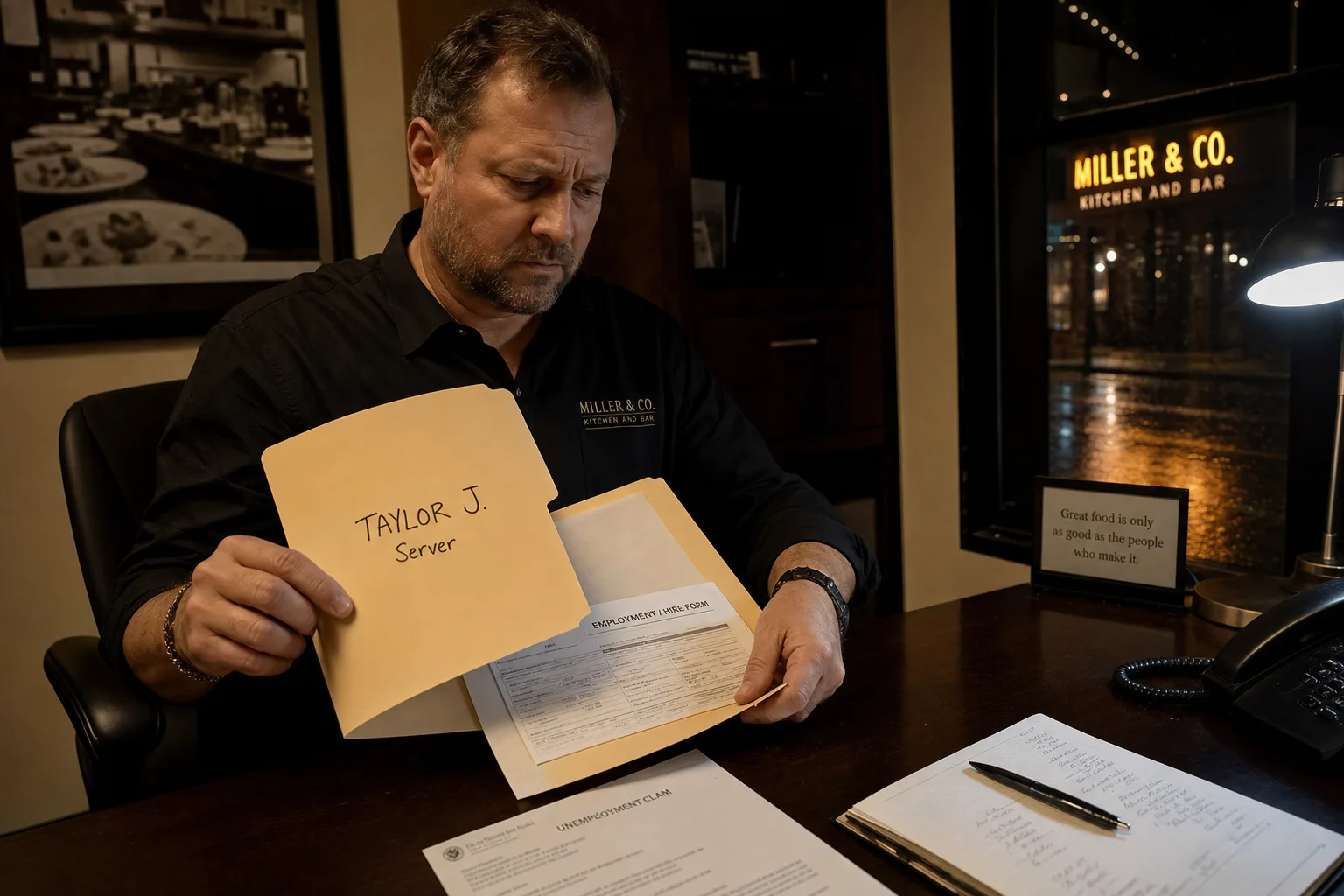
Direct answer: who pays, and what you actually owe
Unemployment insurance is a federal-state system. FUTA (Federal Unemployment Tax Act) is a small federal layer. SUTA (State Unemployment Tax Act) is the state layer that funds weekly checks and that responds to your claims history.
| Question | Short answer |
|---|---|
| Does an unemployment claim cost the employer? | Yes. Employers fund the trust. Awarded claims are charged to the employer account. |
| Does the claimant pay the weekly benefit? | No, except a small employee SUTA share in AK, NJ, and PA. |
| What is FUTA per employee? | About $42/year for most compliant employers (0.6% of the first $7,000). |
| What is the unemployment claim cost to employer beyond FUTA? | Benefit charges plus an experience-rated SUTA increase on all taxable wages, usually for three years. |
| Can you avoid the charge? | Sometimes. If the state agrees the separation was disqualifying misconduct and your file proves it. |
Industry cost ranges you will see cited (UIS, unemployment-services firms, and similar employer-side analyses) cluster like this:
- Average benefits charged to the account: often cited around $4,200, with claims exceeding $10,000–$12,000 when the claimant collects near the state maximum for many weeks.
- Three-year tax impact from a rate increase: commonly illustrated at $4,000–$15,000 for a small-to-mid payroll, more when the wage base is high or headcount is large.
Those are planning ranges, not your determination. Your number is state wage base × your assigned rate, plus whether this claim is chargeable.
Employer calculator
Unemployment claim cost to the employer
This estimates what an awarded unemployment claim can cost the business through UI account charges and a three-year SUTA rate increase. It is not a worker benefits estimator and not a tax filing tool.
Texas planning figures: $9,000 taxable wage base, $605 max weekly benefit, up to 26 weeks. Use the SUTA rate on your state notice.
Yes — the employer pays. In Texas, 1 awarded claim illustrate about $4,312 charged to the UI account. If that raises your SUTA rate by 0.34 points, extra tax is about $1,530 per year, or $4,590 over three years.
- Illustrated charge to UI account
- $4,312
- Weekly benefit used
- $308 × 14 weeks
- Taxable payroll
- $450,000
- Illustrated rate increase
- 0.34 points
- Extra SUTA per year
- $1,530
- Extra SUTA over 3 years
- $4,590
FUTA on this headcount is about $2,100 per year ($42 per employee for most compliant employers). One awarded claim does not, by itself, change FUTA.
Planning estimate only. Experience-rating formulas differ by state. Do not add the UI account charge on top of the three-year tax increase for a typical experience-rated employer — the charge is what drives the rate. Confirm figures with your state UI agency and accountant. Source: Equifax Weekly Benefit and Taxable Wage Guide (state sources as of July 8, 2026); duration from 2026 state UI program summaries.
The two-layer bill (this is the part operators miss)
Layer 1 — Charge to the UI account
When a claim is awarded, the state pays the claimant from the trust fund and, in most experience-rated systems, charges those benefits to your employer account. A simple planning formula:
Charge ≈ weekly benefit × weeks collected
Weekly benefit ≈ min(state maximum, 50% of average weekly wage)
Example: a Texas cook averaging $32,000/year. Half of weekly pay is $308. Texas's 2026 maximum weekly benefit is $605, so the estimate uses $308. Fourteen weeks collected ≈ $4,312 charged.
That charge is not a separate check you mail to the former employee. It is an accounting entry that changes your reserve ratio (or the state's equivalent).
Layer 2 — Experience rating on the whole payroll
SUTA is not a flat fee per claim. It is a percentage of each employee's taxable wages, up to the state wage base. Texas's 2026 wage base is $9,000. Fifty employees fully at the base means $450,000 of taxable payroll. A 0.5-point rate increase is $2,250 extra tax per year, or $6,750 over three years—on top of whatever you already pay.
High wage-base states (Washington $78,200, Oregon $56,700, Hawaii $64,500 in the July 2026 Equifax table) make the same rate bump much more expensive per employee.
Do not add Layer 1 and Layer 2 together for a typical experience-rated restaurant. The charge is the cause; the rate increase is the cash cost over time. Reimbursing employers (some nonprofits and government units) pay dollar-for-dollar instead of a rate. Most restaurants are experience-rated.

Worked restaurant examples
50-person Texas full-service restaurant, one awarded claim
| Input | Figure |
|---|---|
| Headcount | 50 |
| Average wage | $32,000 |
| TX wage base (2026) | $9,000 |
| Taxable payroll | $450,000 |
| Weekly benefit used | $308 (half of weekly pay, under the $605 max) |
| Weeks collected | 14 |
| Illustrated account charge | ~$4,300 |
| If SUTA rises 0.50 points | +$2,250/year → +$6,750 over 3 years |
18-person California cafe, one awarded claim near the weekly cap
California's 2026 wage base is only $7,000, but the weekly maximum is $450. An employee who hits the cap for 20 weeks illustrates $9,000 charged. Eighteen employees × $7,000 = $126,000 taxable payroll. The same $9,000 charge is a much larger share of a small payroll, so the illustrated rate bump is steeper than in the 50-person Texas example. Small shops feel one claim harder.
What "we will just pay it" actually means
Owners sometimes treat unemployment as a cost of turnover. The tax does not care that the employee was a no-call/no-show if the file cannot prove the pattern. You are not paying for compassion. You are paying for a missing timestamp.
State variation is the whole game
A by-state calculator exists because the unemployment claim cost to employer is not the same in Mississippi and Massachusetts.
| State | 2026 wage base | Max weekly benefit | Typical max weeks | Why it matters for employers |
|---|---|---|---|---|
| California | $7,000 | $450 | 26 | Low base, modest weekly cap; volume of claims still moves the rate. |
| Texas | $9,000 | $605 | 26 | Common restaurant market; 14-week claim often lands near $4k charged. |
| Florida | $7,000 | $275 | 12–20 | Lower weekly max; duration moves with the state unemployment rate. |
| New York | $17,600 | $869 | 26 | Higher base and higher weekly cap. |
| Washington | $78,200 | $1,208 | 26 | A small rate increase is expensive per employee. |
| North Carolina | $34,200 | $350 | 12 | Short duration, high wage base. |
| Massachusetts | $15,000 | $1,105 | 30 | Highest weekly maximum with dependents; longest regular duration. |
| Mississippi | $14,000 | $235 | 26 | Lowest weekly maximum in the Equifax July 2026 table. |
Wage bases and weekly maximums: Equifax Weekly Benefit and Taxable Wage Guide, state sources as of July 8, 2026. Duration: 2026 state program summaries. Confirm with your state UI agency before you budget.
The free unemployment claim cost calculator uses those planning figures. It is not the state's official determination.
What does not automatically raise the bill
FUTA, if you stay compliant. The effective federal rate is 0.6% of the first $7,000 ($42/employee) when the state program keeps its credit. One awarded claim does not, by itself, change FUTA.
A claim that is not charged. Layoff for lack of work is usually chargeable. Termination for misconduct can be non-charged if you respond on time and the record shows the employee knew the rule, broke it, and (in many states) had been warned. "Everyone knew he was a problem" is not misconduct proof.
Voluntary quit without good cause. Many states deny benefits when the employee quit without a qualifying reason. You still must respond. Silence often means the claim is granted and charged.
The documentation that changes chargeability
Hearing officers and agency examiners do not tour your dining room. They read dates.
| If the file has this | The state can usually see | If the file has this instead |
|---|---|---|
| Same-shift incident with time, place, witnesses | Contemporaneous facts | A write-up dated after the claim letter |
| Handbook acknowledgment + cited policy | Notice of the rule | "It's in the packet somewhere" |
| Attendance entries on 5/12, 5/19, 6/2 | A pattern | "He was always late" |
| Coaching → written warning → final | Progressive discipline | Termination as the first paper |
| Employee response or refusal to sign | Due process | A manager's memory of the conversation |
That pack is the same pack described in how restaurants lose unemployment claims and how to defend an unemployment claim. Build it against the restaurant employee documentation checklist before you protest the claim. The write-ups in that pack should follow how to write up an employee. The calculator prices the failure. The file decides whether you pay it.
Docu-Coach™ is the floor-level system of record: 10-second voice capture, timestamps, policy tags, and an exportable timeline. It does not replace counsel. It replaces the empty folder.
How to use the number with your accountant (and when to ignore it)
- Pull last year's SUTA notice. Enter that rate, not a guess.
- Enter the state where the work was performed, not where the office is incorporated.
- Use 12–16 weeks if you do not know duration; use the state maximum only as a stress test.
- Treat the three-year extra SUTA as the planning cost for an experience-rated shop.
- If you are a reimbursing employer, ignore the rate-increase line and budget the account charge.
Then decide whether contesting is worth the hours. A charged $4,300 claim that also lifts the rate $2,000 a year is worth a same-week documentation habit. It is rarely worth reconstructing a file after the fact.
Frequently Asked Questions
Does an unemployment claim cost the employer?
Yes. In 47 states and D.C., employees do not fund unemployment insurance. Employers pay federal FUTA tax and state SUTA tax. An awarded claim is charged to the employer's UI account and can raise the SUTA rate applied to the whole payroll for about three years.
How much does an unemployment claim cost an employer?
There is no national flat fee. Benefits charged to the account often run from a few thousand dollars to more than $10,000 depending on the state's weekly maximum and weeks collected. The larger cost is usually the SUTA rate increase multiplied across taxable payroll for two to three years.
What is the unemployment claim cost to employer if we contest and win?
If the state finds the separation was for disqualifying misconduct and does not charge your account, you typically avoid both the benefit charge and the experience-rating increase. You still spend manager and HR time. Contemporaneous documentation is what makes a contest winnable.
Does the employee pay for their unemployment check?
Almost never. Only Alaska, New Jersey, and Pennsylvania collect a small employee share. The weekly benefit still comes from the employer-funded trust, and awarded claims still affect the employer's experience rating.
Is FUTA the unemployment claim cost to employer?
No. FUTA is a separate federal tax of $42 per employee per year for most compliant employers (0.6% of the first $7,000). The claim-driven cost is state SUTA experience rating, not FUTA—unless the state loses its FUTA credit.
How long does one awarded claim affect our tax rate?
Most states use a two- or three-year lookback when they set the next SUTA rate. One charged claim can influence more than one rate year. That is why a 'small' claim is not small on a 40-person restaurant payroll.
Do restaurants really lose claims they should win?
Yes, usually because the file is empty: no dated attendance pattern, no handbook acknowledgment, no FACT write-up, and a termination memo created after the claim letter arrived. Hearing officers weigh records, not breakroom consensus.
How does Docu-Coach™ change the unemployment claim cost to employer?
It does not pay the tax. It creates the contemporaneous incident, coaching, and attendance records that let you contest claims that should not be charged—and it starts at $50/month, which is less than one poorly documented separation often costs.
Common mistakes
- Assuming the employee "costs the company unemployment" as a moral statement instead of checking whether the claim is chargeable.
- Ignoring the wage base. A 0.4-point increase in Washington is not a 0.4-point increase in Florida.
- Adding FUTA, the weekly benefit, and three years of SUTA into one inflated scare number.
- Missing the protest deadline because the notice sat in a GM's inbox during Saturday brunch.
- Building the personnel file on the day of the hearing.
Conclusion
How much does an unemployment claim cost an employer? Enough to notice on a restaurant P&L, and more than most operators think, because the cost is a tax rate, not a single benefit check. Does an unemployment claim cost the employer? Yes—unless the state does not charge it. Unemployment claim cost to employer is therefore two jobs: estimate the tax with a by-state model, and keep contemporaneous records so claims that should not be charged are not charged.
Run the employer calculator with your SUTA notice. If the three-year extra tax is larger than a year of structured documentation, the file is the cheaper control.
Docu-Coach™ starts at $50/month for 50 employees and one location, with a 30-day trial and no charge until day 31. It is not legal or tax advice. Confirm rates with your state unemployment agency and your accountant.
Explore this topic
Related Resources
How Restaurants Lose Unemployment Claims Due to Poor Documentation
Restaurants lose UI claims when they cannot prove misconduct with dated records—not when they lack a lawyer. Build the documentation pack hearings require.
5 min read · September 2026

The True Cost of Missing Employee Documentation
Empty employee files cost UI tax hikes, legal fees, manager hours, and turnover—not just 'HR hassle.' See the real dollars operators leave on the table.
5 min read · September 2026
How to Defend an Unemployment Claim
How to Defend an Unemployment Claim for operators and HR. Step-by-step guidance, legal risk, examples, and best practices.
2 min read
Restaurant Employee Documentation Checklist
Same-shift restaurant employee documentation checklist for FOH, BOH, attendance, alcohol, cash, and guest complaints—so a write-up or unemployment file is ready before Saturday brunch.
9 min read · September 2026

The Documentation Gap That Creates Wrongful Termination Risk
Informal warnings with no file create wrongful termination and constructive discharge exposure. Close the gap with progressive discipline that holds up.
5 min read · September 2026

How to Build a Defensible Employee Record
A defensible employee record needs five record types, FACT language, and progressive discipline—not a full drawer. Build audit-ready files operators use.
4 min read · September 2026