Compliance & Legal
The Documentation Gap That Creates Wrongful Termination Risk
Key takeaways
- The documentation gap—the space between informal warnings managers give on the floor and dated entries in the personnel file—is where wrongful termination and constructive discharge claims gain traction.
- A consistent personnel file checklist makes those missing coaching, incident, and discipline records visible before separation.
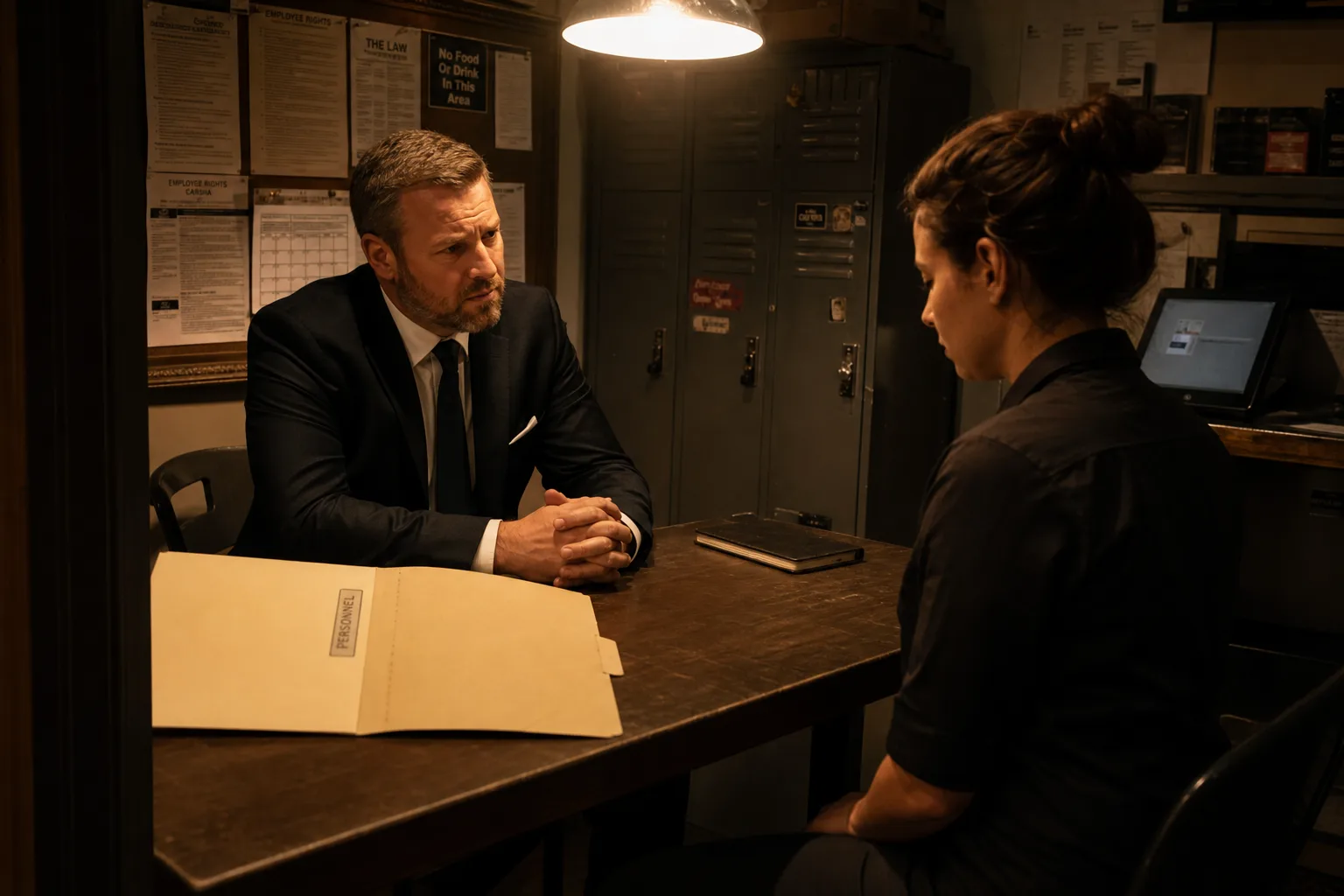
- When you terminate Maria after "years of problems" but the file shows hire paperwork and silence, Maria's attorney does not need to prove you are wrong—they need to prove you cannot prove you are right.
- You coached in the walk-in, pulled her aside at expo, and told yourself HR would "formalize it if it got worse.
- " It got worse on a night you were down two cooks and she walked out mid-shift.
- At-will employment lets you separate, but empty files let plaintiffs frame the story: sudden, personal, maybe retaliatory.
The Documentation Gap That Creates Wrongful Termination Risk
The documentation gap—the space between informal warnings managers give on the floor and dated entries in the personnel file—is where wrongful termination and constructive discharge claims gain traction. A consistent personnel file checklist makes those missing coaching, incident, and discipline records visible before separation. When you terminate Maria after "years of problems" but the file shows hire paperwork and silence, Maria's attorney does not need to prove you are wrong—they need to prove you cannot prove you are right.
You are not careless. You coached in the walk-in, pulled her aside at expo, and told yourself HR would "formalize it if it got worse." It got worse on a night you were down two cooks and she walked out mid-shift. At-will employment lets you separate, but empty files let plaintiffs frame the story: sudden, personal, maybe retaliatory. That gap costs settlements, UI losses, and months of distraction.
Root Cause Analysis
Informal-only management. Verbal coaching without same-day logs is legally invisible.
Escalation without records. Each "last chance" conversation that never becomes a write-up resets the narrative to zero.
Inconsistent standards. Server A gets written up; Server B gets jokes for the same behavior—disparate treatment evidence.
Retaliation timing. Termination weeks after a complaint without documented performance issues invites EEOC scrutiny.
Constructive discharge triggers. Cutting hours, hostile assignments, or public humiliation without investigation notes support "forced to quit" theories.
Manager amnesia under oath. The MOD who lived the pattern transferred; the file never moved.
The Actionable Framework
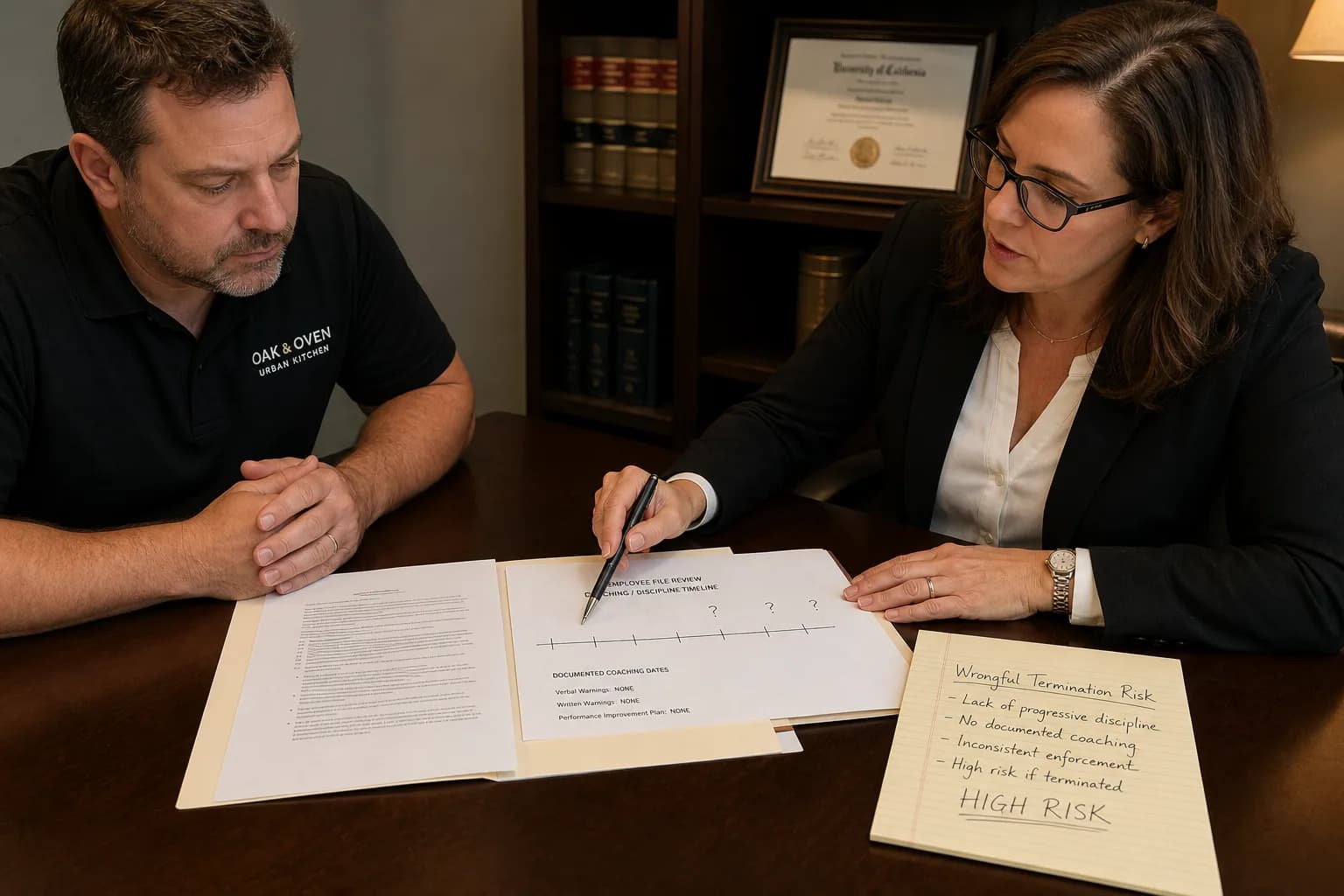
Empty File vs. Progressive Discipline Timeline
| Stage | Empty file (high risk) | Defensible timeline |
|---|---|---|
| Month 1 | "Everyone knew she was difficult" | Dated coaching: sidework incomplete 3/5 |
| Month 2 | Verbal warnings (undocumented) | Written warning 4/2, handbook §4.3 cited |
| Month 3 | Guest complaint (no record) | Incident entry 5/10, witness MOD Jones |
| Month 4 | Termination surprise | Final warning 5/28; termination 6/15 with summary |
Close-the-Gap Protocol (same shift)
- Trigger rule — Any behavior that would justify termination if repeated gets a dated entry that shift.
- FACT entries — Observable behavior only; cite policy section.
- Employee voice — Capture their response or refusal.
- Escalation map — Match handbook tiers; no skip unless zero-tolerance.
- Pre-flight review — HR pulls timeline 48 hours before termination conversation.
Compliance warning: Never document protected-class commentary (race, gender, age, religion, pregnancy, disability speculation). Document behavior and policy only. Bias in files becomes Exhibit A.
Termination Readiness Scorecard
| Criterion | Met? |
|---|---|
| Issue coached in writing at least once before final action (unless zero-tolerance) | ☐ |
| Each entry dated same day as event | ☐ |
| Handbook/policy cited in write-ups | ☐ |
| Employee response documented | ☐ |
| No gap suggesting retaliation after protected activity | ☐ |
| Separation summary prepared | ☐ |
The Paper Trail and Legal Safeguard
Wrongful termination is often a story fight. Your story needs dates.
Do
- Document coaching after every serious floor conversation within 2 hours.
- Use progressive discipline per handbook unless investigation supports immediate action.
- Separate harassment/medical files; document investigations with restricted access.
- Have second manager witness refused signatures.
Do not
- Terminate for "not a culture fit" without behavioral FACTs.
- Promise "this won't go in your file" then terminate citing undocumented history.
- Backfill coaching notes after demand letter arrives.
- Let personal conflict language enter official records.
| Gap pattern | Plaintiff narrative |
|---|---|
| No file, sudden termination | "Blindsided / pretext for discrimination" |
| Verbal-only history | "Employer invented reasons after the fact" |
| Inconsistent discipline across staff | "Selective enforcement" |
Frequently Asked Questions
What is the documentation gap in wrongful termination cases?
The gap between informal warnings managers remember and formal records in the personnel file. When termination follows years of undocumented 'talks,' employees claim they were blindsided—strengthening wrongful termination and retaliation arguments.
What is constructive discharge?
Constructive discharge occurs when working conditions are made intolerable enough that a reasonable employee would feel forced to quit—often alleged when documentation of coaching and investigation is missing.
Does at-will employment eliminate documentation needs?
No. At-will allows termination without cause in many states, but undocumented separations still lose unemployment hearings and invite discrimination or retaliation claims where motive is inferred from empty files.
What is progressive discipline?
Escalating, documented steps—verbal coaching, written warning, final warning, termination—for performance or conduct issues, with dates and policy citations. Gaps in the chain create wrongful termination appearance.
How does retaliation connect to documentation?
After a complaint (harassment, wage, safety), terminations without contemporaneous performance records look retaliatory. Document legitimate issues same shift, every shift.
What should be in the file before termination?
Handbook ack, dated coaching on the issue, FACT-based write-ups, employee responses, attendance/incident pattern, investigation notes if applicable, and separation summary.
Can I terminate without prior write-ups?
Zero-tolerance policies (violence, theft, serious harassment) may allow immediate separation if handbook states so and investigation is documented—counsel should review.
How does Docu-Coach™ reduce termination risk?
Same-shift voice capture builds progressive timelines automatically, enforces structured fields, and gives counsel exportable history before separation conversations.
Common Mistakes
- Assuming at-will means "no paper needed"
- Saving write-ups for "when we are ready to fire"
- Coaching in group settings without individual dated follow-up
- Mixing personality judgments with policy violations
- Terminating during active complaint without counsel review
- Letting high emotion drive documentation language
- Failing to update files when managers rotate stores
Natural Solution Contextualization
Closing the documentation gap is not about creating paper to justify firings you already decided—it is about fair notice so good employees improve and separations stop feeling like ambushes to everyone involved, including juries and hearing officers.
Docu-Coach™ captures the conversation you already have on the floor and turns it into a timestamped timeline before the gap opens. When termination is the right call, counsel opens a file that tells a dated story—not a memory.
Pull three active problem employees' records today. If any timeline has a gap longer than 30 days between incidents and entries, run the close-the-gap protocol this week. The separation you prevent—or defend—starts with today's shift note.
Explore this topic
Related Resources
How to Build a Defensible Employee Record
A defensible employee record needs five record types, FACT language, and progressive discipline—not a full drawer. Build audit-ready files operators use.
4 min read · September 2026
How to Write Up a Restaurant Employee Legally: FACT Method and Defensible Templates
Stop writing 'bad attitude' write-ups that fail in HR. Use the FACT method, strip emotion from discipline, and generate defensible corrective actions in Docu-Coach™.
8 min read · September 2026
How Much Does an Unemployment Claim Cost an Employer?
Does an unemployment claim cost the employer? Yes. See the unemployment claim cost to employer—UI charges, SUTA rate hikes, and a free by-state calculator.
10 min read · September 2026
How Restaurants Lose Unemployment Claims Due to Poor Documentation
Restaurants lose UI claims when they cannot prove misconduct with dated records—not when they lack a lawyer. Build the documentation pack hearings require.
5 min read · September 2026

Paper Personnel Files vs Digital Documentation
Paper files fail on the floor; generic cloud folders fail on structure. Compare paper vs purpose-built digital HR documentation for restaurants.
5 min read · September 2026

The True Cost of Missing Employee Documentation
Empty employee files cost UI tax hikes, legal fees, manager hours, and turnover—not just 'HR hassle.' See the real dollars operators leave on the table.
5 min read · September 2026