Restaurant HR
Restaurant Employee Documentation Checklist
Key takeaways
- Use this page when you run a restaurant, bar, or multi-unit hospitality group.
- For the generic hire-packet and I-9 list that applies to any employer, see the personnel file checklist.
- For write-up language, use how to write up an employee and employee write-up examples.
- A generic personnel file answers "did we hire this person correctly?
- " A restaurant file has to answer "what happened on a Saturday night, at which station, under which MOD, and did the employee already know the rule?
- Restaurants lose that second question for predictable reasons:
Restaurant employee documentation checklist (same-shift, hearing-ready)
A restaurant employee documentation checklist is the floor-level file you can hand a hearing officer: hire and policy acknowledgments, same-shift FOH/BOH incident notes, attendance matched to the POS schedule, alcohol and cash events, guest-complaint facts, progressive coaching, and a same-day separation summary. It is not a generic personnel folder with an I-9 and a write-up dated after the claim.
Use this page when you run a restaurant, bar, or multi-unit hospitality group. For the generic hire-packet and I-9 list that applies to any employer, see the personnel file checklist. For write-up language, use how to write up an employee and employee write-up examples.
Why restaurants need a different checklist
A generic personnel file answers "did we hire this person correctly?" A restaurant file has to answer "what happened on a Saturday night, at which station, under which MOD, and did the employee already know the rule?"
Restaurants lose that second question for predictable reasons:
- Rush kills the record. The expo line, a walkout, or a no-show during brunch gets a text in a group chat and never becomes a dated file entry.
- MOD rotation. The manager who coached the bartender transferred stores; the coaching stayed in their head.
- Labels instead of floor facts. "Bad attitude" does not map to a guest complaint at table 12 at 8:15 p.m. or a refused ID check at the bar.
- Schedule without pattern. Payroll shows hours. It does not show three dated NCNS entries with coaching between them.
- Hire packet mistaken for a defense file. Food-handler cards and a signed handbook help. They do not replace same-shift incident notes.
This page scores the file. The restaurant employee documentation pillar covers the record types that fill it—coaching, write-up, incident, attendance, PIP, investigation, separation—and the FACT language each one needs.
If the file is already thin and a claim is coming, read how restaurants lose unemployment claims and how to defend an unemployment claim.
Hire and compliance (once per employee)
Complete these before the first solo shift. Store I-9s in the legally required separate file—not in the shared MOD drawer.
| Item | Ready? | Restaurant note |
|---|---|---|
| Offer / role / start date | ☐ | Include station (FOH, BOH, bar) and home store |
| I-9 (separate storage) | ☐ | Not in the floor binder |
| Handbook acknowledgment | ☐ | Dated; keep the version they signed |
| Attendance / NCNS policy ack | ☐ | Cite this section in later write-ups |
| Tip policy or tip-credit ack | ☐ | Servers, bartenders, hosts if they share tips |
| Alcohol-service card or TIPS/ServSafe Alcohol | ☐ | Expiration date on file |
| Food-handler or food-safety cert | ☐ | BOH and anyone running food |
| Allergen / ticket-procedure training | ☐ | Especially expo and line cooks |
| Cash, void, and comp rules ack | ☐ | Cashiers, bartenders, GMs |
Missing one hire item is a compliance gap. It is not a reason to skip same-shift incident notes.
Same-shift incident capture (every FOH or BOH event)
Document within two hours of the event—voice note on the floor is fine if you file it the same shift.
| Capture field | What to write | Skip this |
|---|---|---|
| When / where | Date, clock time, station or section | "During rush" |
| Who | Employee + MOD on duty | "The night team" |
| Observable behavior | Quotes, ticket number, table/check, what was 86'd | "Attitude," "lazy," "toxic" |
| Policy | Handbook section or posted station standard | "Everyone knows that" |
| Witnesses | Names still on the clock | "The whole shift saw it" |
| Employee response | Their words or "declined to comment" | A later reconstructed quote |
| Follow-up | Coaching date or write-up next step | "We'll see how it goes" |
Restaurant events that belong in the file the same night
- Guest complaint — table or check number, what the guest said, what the employee did, comps if any. File a verified guest-facing miss on the restaurant rude-to-guest write-up.
- No-call / no-show or late — scheduled start from POS or 7shifts/HotSchedules, actual arrival or absence, who covered the section. For a ghosted shift, use the restaurant no-call/no-show write-up. For a late clock-in, use the restaurant tardiness write-up. For an unapproved early-out or unauthorized/extended break, use the restaurant leaving-early write-up.
- Phone use on the line — station, observation times, whether they were clocked in, guest or ticket impact. File it on the restaurant cell-phone write-up, not as an attendance occurrence.
- Dress code / uniform — missing piece, shoes, hair or jewelry, whether a spare was offered. File it on the restaurant dress-code write-up, not as an attendance occurrence.
- Cash, void, or comp variance — amount, check number, who approved, whether the drawer was shared.
- Alcohol — failed ID check, over-service, or serving after cut-off; cite the alcohol policy and card status.
- Allergen or ticket error — ticket time, item, who fired it, guest impact.
- Insubordination on expo — exact words, location (expo, dish pit, bar well), witnesses still on shift. File a refused lawful work order on the restaurant insubordination write-up.
- Social media — guest photo or video, public complaint about a shift or manager, private workplace info on TikTok/Instagram/Facebook. File the published post on the restaurant social media write-up.
- Documented product or cash taking — food/product walked out, unpaid comps, tip-jar or till cash seen leaving with an employee. File the observed taking on the restaurant employee theft write-up. A drawer short with no observed taking stays on the cash drawer shortage write-up.
- Tip-out or tip-pool miss — which tips, amount if known, tip report, who was owed. File the withheld share on the restaurant tip-theft write-up.
- Safety — slip, burn, fight, or guest altercation; pair the employee note with the incident report.
- Walkout / dine-and-dash involving staff — who was assigned the table, last actions, MOD notified.
Attendance and schedule proof
Unemployment boards treat "always late" as a story. They treat dated entries as a pattern.
- Log each late, early-out, or NCNS the same day with scheduled vs. actual time.
- Attach or cite the POS or scheduling export for that date.
- Coach on the pattern between occurrences—not only on the day you terminate.
- Note coverage impact: section collapsed, tickets delayed, bartender solo for a 90-minute rush.
- Do not bundle three Saturdays into one Friday memo.
Progressive discipline pack (before a restaurant write-up)
| Step | In the file | Typical restaurant miss |
|---|---|---|
| Coaching | Same-shift note, policy cited, follow-up date | "I talked to him at the expo" |
| Written warning | FACT language, prior coaching listed | First paper on termination day |
| Final warning | Same issue or published zero-tolerance | New issue stacked without dates |
| Separation summary | Who, when, reason, property, final pay | Termination text with no file |
Draft the write-up from the checklist, not from memory. Use employee write-up examples for FACT replacements ("left sidework incomplete" instead of "lazy").
Pre-termination / unemployment pack
Pull this before you separate—not when the claim letter arrives.
| Item | Ready? |
|---|---|
| Handbook + attendance/tip/alcohol acks | ☐ |
| Dated coaching on the same issue | ☐ |
| Write-up uses FACT language, not labels | ☐ |
| Attendance or incident log matches POS schedule | ☐ |
| Guest, cash, or alcohol details if that is the reason | ☐ |
| Employee response or refusal documented | ☐ |
| Witness names still employed or reachable | ☐ |
| Separation summary drafted same day | ☐ |
If more than two boxes are empty, delay separation unless policy and investigation support immediate action. Price a charged claim with the unemployment claim cost calculator. The separation summary itself—stated reason, prior steps by date, property and access recovered—is built in restaurant termination documentation.
FOH vs. BOH extras
Front of house (server, host, bartender) — the standards and evidence sources behind these are in documenting servers.
- Tip pooling or tip-credit acknowledgment
- Guest complaint with table/check
- Sidework or closing-checklist failures
- ID check and over-service (bar)
- Walkout assigned to that server's section
Back of house (line, prep, dish, expo) — the kitchen equivalents are in documenting line cooks.
- Ticket or allergen errors with fire time
- Food-safety or temperature events tied to a person
- Expo-line quotes and witnesses
- Station assignment that night (grill, sauté, dish)
Multi-unit
- Home store vs. borrowed-store incidents in one timeline
- Area-director sample: three recent incidents per store, same-day dating, progression present
Common restaurant mistakes
- Using the group text as the system of record
- Writing the first formal note on the day of termination
- Citing "policy" you cannot point to by handbook section
- Documenting personality instead of a table, ticket, or clock time
- Leaving alcohol or cash events in the safe log only—never in the employee file
- Assuming a complete hire packet wins a UI hearing
- Letting a transferred MOD take the coaching history with them
How to run the checklist this week
- Pick one problem employee and score the hire table and the pre-termination table.
- Capture the next floor incident within two hours—guest complaint, NCNS, or expo quote.
- File it to the official record, not your phone.
- If you write someone up, pull how to write up an employee so the language matches the checklist.
- If a claim is already filed, export the pack and follow how to defend an unemployment claim.
Conclusion
Restaurant employee documentation is a same-shift habit, not a drawer you open after the claim. This checklist is the restaurant-specific file review: FOH and BOH events, schedule proof, alcohol and cash, guest facts, and progressive steps. The generic personnel file checklist still covers hire packets and I-9 storage. Docu-Coach™ timestamps floor captures so the checklist is a review, not a reconstruction. Book a demo to see the workflow.
Frequently Asked Questions
What belongs on a restaurant employee documentation checklist?
Hire paperwork plus same-shift FOH/BOH records: handbook and tip-policy acknowledgments, food-handler or alcohol-service cards, dated no-call/no-show entries matched to the POS schedule, guest-complaint notes with table or check number, cash or void variances, coaching and write-ups in FACT language, and a same-day separation summary if you terminate.
How is this different from a generic personnel file checklist?
A generic personnel file checklist covers hire docs, I-9 storage, and a discipline folder. A restaurant checklist adds floor-level items that hearings actually ask for: rush-period timestamps, station or section, POS or schedule proof, alcohol and cash events, guest names or check numbers, and which MOD was on the floor when the incident happened.
What FOH records do restaurants need that BOH files often miss?
Servers and hosts need guest-complaint entries with table, time, and check number; walkout or dine-and-dash notes if staff were involved; tip-policy acknowledgments; sidework or closing-checklist failures; and quotes from the floor—not 'attitude' labels. Bartenders also need ID-check and over-service notes.
What BOH records do restaurants need?
Cooks and dishwashers need allergen or ticket-error incidents, temperature or food-safety events tied to a person, insubordination quotes on the expo line, late or NCNS entries matched to the posted schedule, and witness names from the same shift. Do not store medical diagnoses in the floor file.
How do I document a no-call/no-show during Saturday brunch?
Same shift, ideally within two hours: scheduled start from the POS or scheduling tool, actual absence, whether anyone called and when, coverage impact (section collapsed, tickets delayed), MOD name, and the handbook attendance section. One NCNS is a record. Three dated NCNS entries with coaching between them is a pattern.
Do food-handler and alcohol-service cards belong in the personnel file?
Yes—copies or expiration dates belong with hire and compliance docs, separate from I-9 storage. If you discipline for an expired card or a failed ID check, cite the card status and the policy in the same-shift incident entry.
What should I have before firing a restaurant employee for attendance?
Handbook acknowledgment, the attendance or NCNS rule cited by section, dated occurrences that match the schedule, coaching between events, the employee's response or refusal to comment, and a same-day separation summary. If two of those boxes are empty, coach and document before you separate—unless a zero-tolerance rule and investigation support immediate action.
Why do restaurants lose unemployment claims even with a complete hire packet?
Hire paperwork proves the person was employed. It does not prove they knew a rule, broke it, and had fair notice. Hearing officers want contemporaneous incident, attendance, and coaching records—not an I-9 and a termination email written after the claim letter arrived.
Related Resources
Restaurant Employee Documentation
What restaurant managers should document, how fast, and where it belongs. Record types, FACT language, progressive discipline steps, and a monthly file audit for FOH and BOH.
11 min read · September 2026
How to Write Up an Employee
How to Write Up an Employee for operators and HR. Step-by-step guidance, legal risk, examples, and best practices.
3 min read
Employee Write-Up Examples
Employee Write-Up Examples for operators and HR. Step-by-step guidance, legal risk, examples, and best practices.
3 min read
Restaurant No-Call No-Show Write-Up
How restaurant managers document a no-call/no-show the same day, write it up in FACT language, and keep progressive discipline ready for an unemployment hearing.
8 min read · September 2026
How to Defend an Unemployment Claim
How to Defend an Unemployment Claim for operators and HR. Step-by-step guidance, legal risk, examples, and best practices.
2 min read
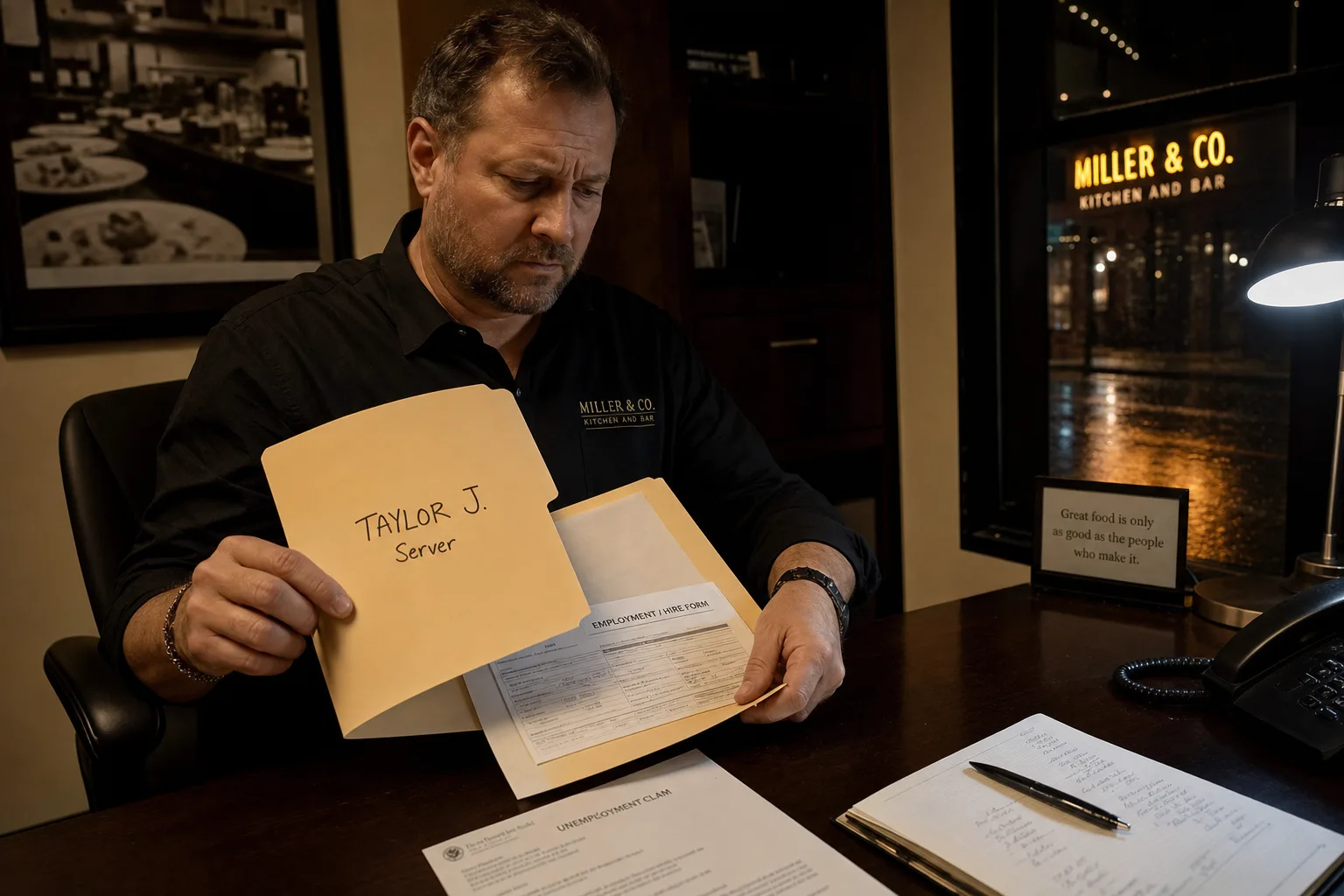
How Restaurants Lose Unemployment Claims Due to Poor Documentation
Restaurants lose UI claims when they cannot prove misconduct with dated records—not when they lack a lawyer. Build the documentation pack hearings require.
5 min read · September 2026