Compliance & Legal
How to Build a Defensible Employee Record
Key takeaways
- A defensible employee record combines five record types—hire/compliance, incidents, coaching, attendance patterns, and separation summaries—with FACT language, same-shift timestamps, and progressive discipline that shows fair notice before termination.
- The restaurant employee documentation checklist turns those five record types into a repeatable file review.
- You inherit empty files from prior GMs, short-staffed shifts, and a culture that treats documentation as optional until legal calls.
- Building defensible records feels like extra work until the first unemployment hearing—or the first time a reliable employee asks why nothing ever happens to the coworker who no-shows every weekend.
- " Each MOD files differently—or not at all.
- "Attitude" entries do not survive EEOC or UI review.
How to Build a Defensible Employee Record
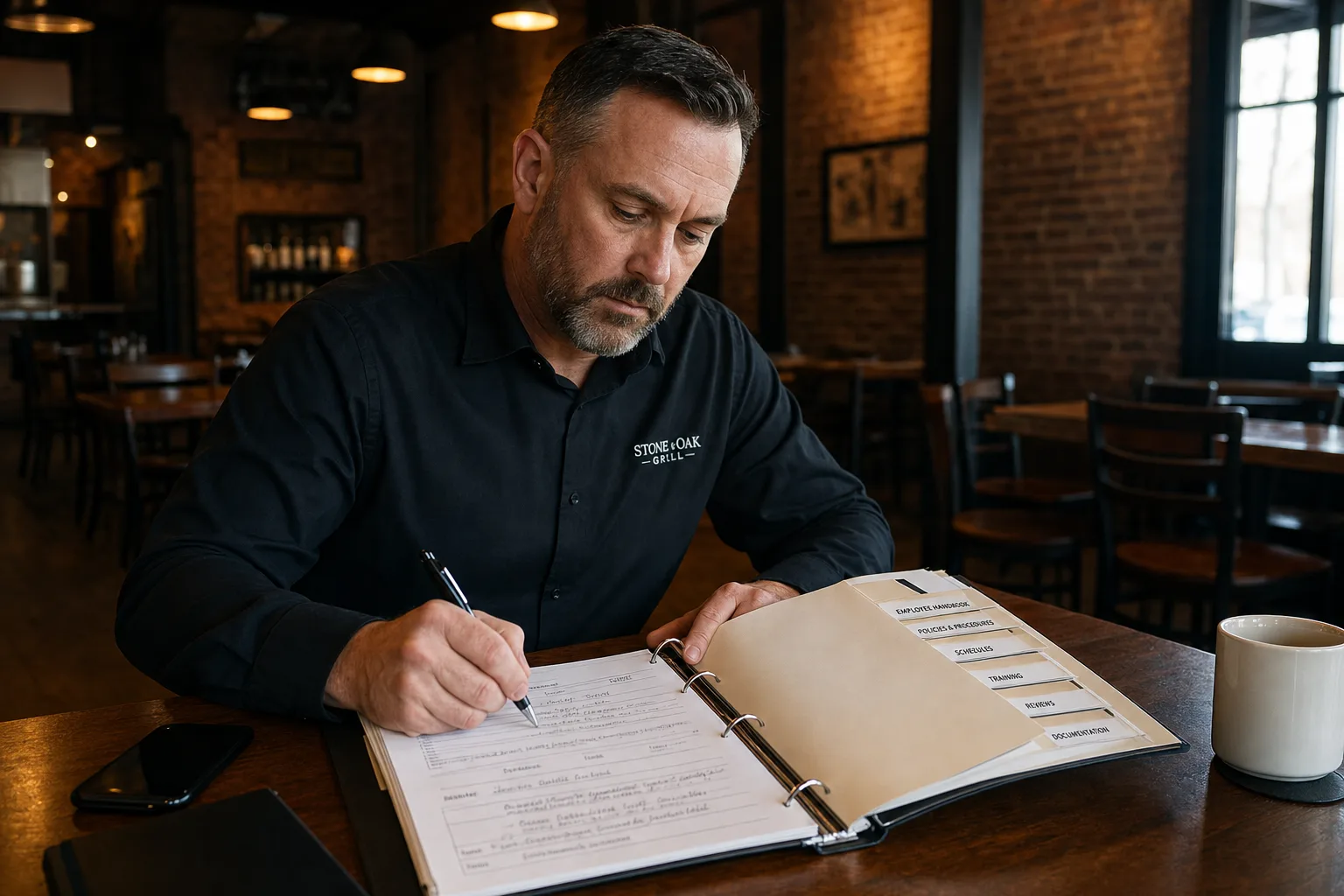
A defensible employee record combines five record types—hire/compliance, incidents, coaching, attendance patterns, and separation summaries—with FACT language, same-shift timestamps, and progressive discipline that shows fair notice before termination. It is not a thick folder; it is a chronological timeline a stranger could read and understand what happened, when, under which policy, and what the employee was told. The restaurant employee documentation checklist turns those five record types into a repeatable file review.
You inherit empty files from prior GMs, short-staffed shifts, and a culture that treats documentation as optional until legal calls. Building defensible records feels like extra work until the first unemployment hearing—or the first time a reliable employee asks why nothing ever happens to the coworker who no-shows every weekend.
Root Cause Analysis
No standard for "what good looks like." Each MOD files differently—or not at all.
Label-heavy language. "Attitude" entries do not survive EEOC or UI review.
Broken progression. Write-up appears without prior dated coaching on the same issue.
Attendance without pattern. Single late note without trend data fails misconduct arguments.
Missing employee voice. One-sided records look punitive.
Sensitive data mishandled. Harassment details in shared folders create separate liability.
The Actionable Framework
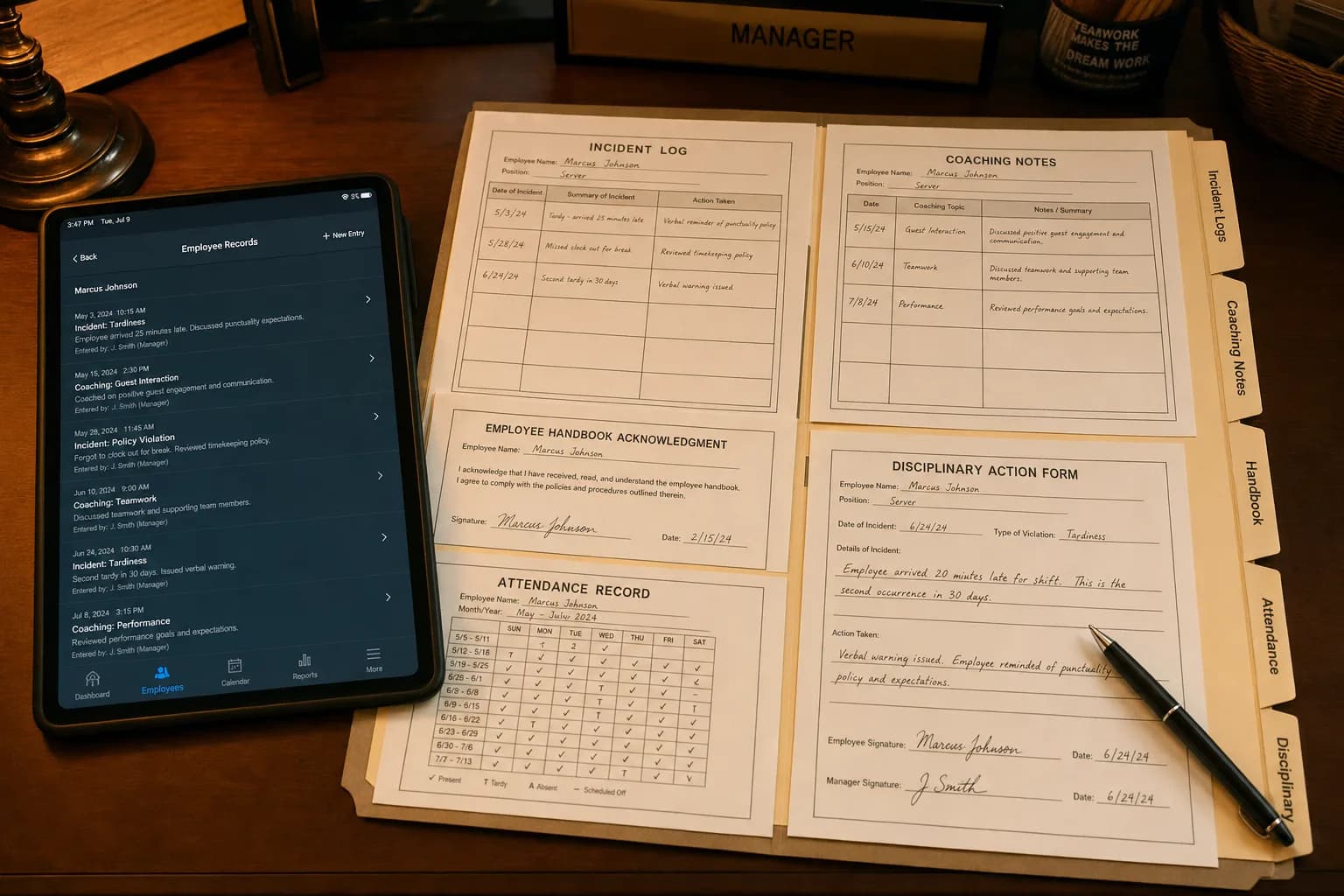
Incomplete File vs. Audit-Ready File
| Component | Incomplete (typical) | Audit-ready |
|---|---|---|
| Hire docs | Handbook only | Handbook ack, policies, role docs dated |
| Incidents | Verbal lore | Dated FACT entries with witnesses |
| Coaching | "Talked to him" | Same-day log with policy + response |
| Attendance | Payroll printout only | Pattern entries tied to schedule |
| Discipline | One surprise write-up | Verbal → written → final chain |
| Separation | Termination email | Summary: reason, date, property, final pay |
The Five Record Types (build in this order)
- Hire & compliance — I-9, handbook acknowledgment, training certs, role expectations.
- Incident reports — Guest complaints, safety, alcohol, violence, theft allegations (investigate before discipline).
- Coaching entries — Performance conversations with FACT summary and follow-up date.
- Attendance pattern log — Each late, NCNS, or early out same day with schedule proof.
- Separation summary — Final reason, progressive steps referenced, who conducted, dates.
FACT Entry Template (every coaching/incident)
Date/time/location:
Employee:
Behavior observed (facts, quotes):
Policy/expectation violated:
Witnesses:
Immediate action:
Employee response:
Follow-up date:
Manager name/title:
Pro tip: If you cannot complete the "behavior observed" line in two factual sentences, pause the write-up—gather witnesses first. Vague entries hurt more than waiting one shift.
Weekly File QA (area director, 15 minutes per store)
- Random sample: 3 employees with recent incidents
- Check: same-day dating, FACT language, progression present?
- Coach GMs on gaps before they become hearings
The Paper Trail and Legal Safeguard
Defensible records support UI defense, EEOC responses, and internal fairness.
Do
- Document same shift; voice capture counts if structured immediately after.
- Cite handbook sections by number in write-ups.
- Store investigations in HR-restricted files.
- Apply consistent consequences across shifts.
Do not
- Diagnose medical or mental health in official records.
- Include protected-class commentary.
- Backdate or alter entries—add corrected addendum if error found.
- Promise off-record conversations you later cite in termination.
Frequently Asked Questions
What makes an employee record defensible?
Contemporaneous, dated entries using FACT language (facts, policy, context, target), progressive discipline for recurring issues, employee responses captured, and consistent standards across shifts and locations.
What are the five record types every file needs?
Hire/compliance docs, incident reports, coaching entries, attendance pattern logs, and separation summaries—investigation notes when applicable in HR-restricted storage.
How quickly should entries be added?
Same shift as the event, ideally within 2 hours. Delayed entries lose credibility in unemployment and EEOC proceedings.
What is FACT documentation?
Factual observation, Action/policy violated, minimal Context, and Target/consequence. It replaces labels like 'bad attitude' with observable behaviors.
Should verbal coaching be in the file?
Yes—document same day with date, topic, FACT summary, and employee response. Undocumented verbal warnings do not count in hearings.
What belongs in HR-only files?
Harassment investigations, medical/accommodation notes, and legal holds—floor managers get need-to-know summaries only.
How do multi-unit operators standardize records?
One schema for record types, required fields, naming, and review cadence—enforced by tooling, not honor system.
How does Docu-Coach™ build defensible records?
Voice capture on the floor auto-structures FACT fields, timestamps entries, links them to employee timelines, and supports area roll-up review.
Common Mistakes
- Waiting for "enough" incidents before first entry
- Bundling multiple employees in one note
- Using group texts as the record
- Filing only negative events—skip positive coaching that shows development
- Ignoring file when employee transfers stores
- Letting terminated files sit without separation summary
- Copy-pasting generic write-up language without incident-specific facts
Natural Solution Contextualization
Building a defensible employee record is a habit system, not a quarterly project. The operators who sleep well before terminations are not necessarily softer—they are clearer on paper, earlier in the pattern, and consistent when the floor is hardest.
Docu-Coach™ enforces the five record types through floor-ready voice capture: managers speak facts between tickets; the timeline builds itself with timestamps and structured fields HR can export before anyone says "we never documented that."
Open one problem employee's file tonight. Score it against the audit-ready column. Every empty row is a task for tomorrow's shift—not next quarter's initiative.
Explore this topic
Related Resources
Restaurant Employee Documentation Checklist
Same-shift restaurant employee documentation checklist for FOH, BOH, attendance, alcohol, cash, and guest complaints—so a write-up or unemployment file is ready before Saturday brunch.
9 min read · September 2026
How to Write Up an Employee
How to Write Up an Employee for operators and HR. Step-by-step guidance, legal risk, examples, and best practices.
3 min read
How to Write Up a Restaurant Employee Legally: FACT Method and Defensible Templates
Stop writing 'bad attitude' write-ups that fail in HR. Use the FACT method, strip emotion from discipline, and generate defensible corrective actions in Docu-Coach™.
8 min read · September 2026
Restaurant Employee HR Documentation System: From Scattered Notes to Audit-Ready Files
Empty employee files and sticky-note write-ups cost you at unemployment hearings. Build a unified restaurant HR documentation system that scales across locations.
8 min read · September 2026
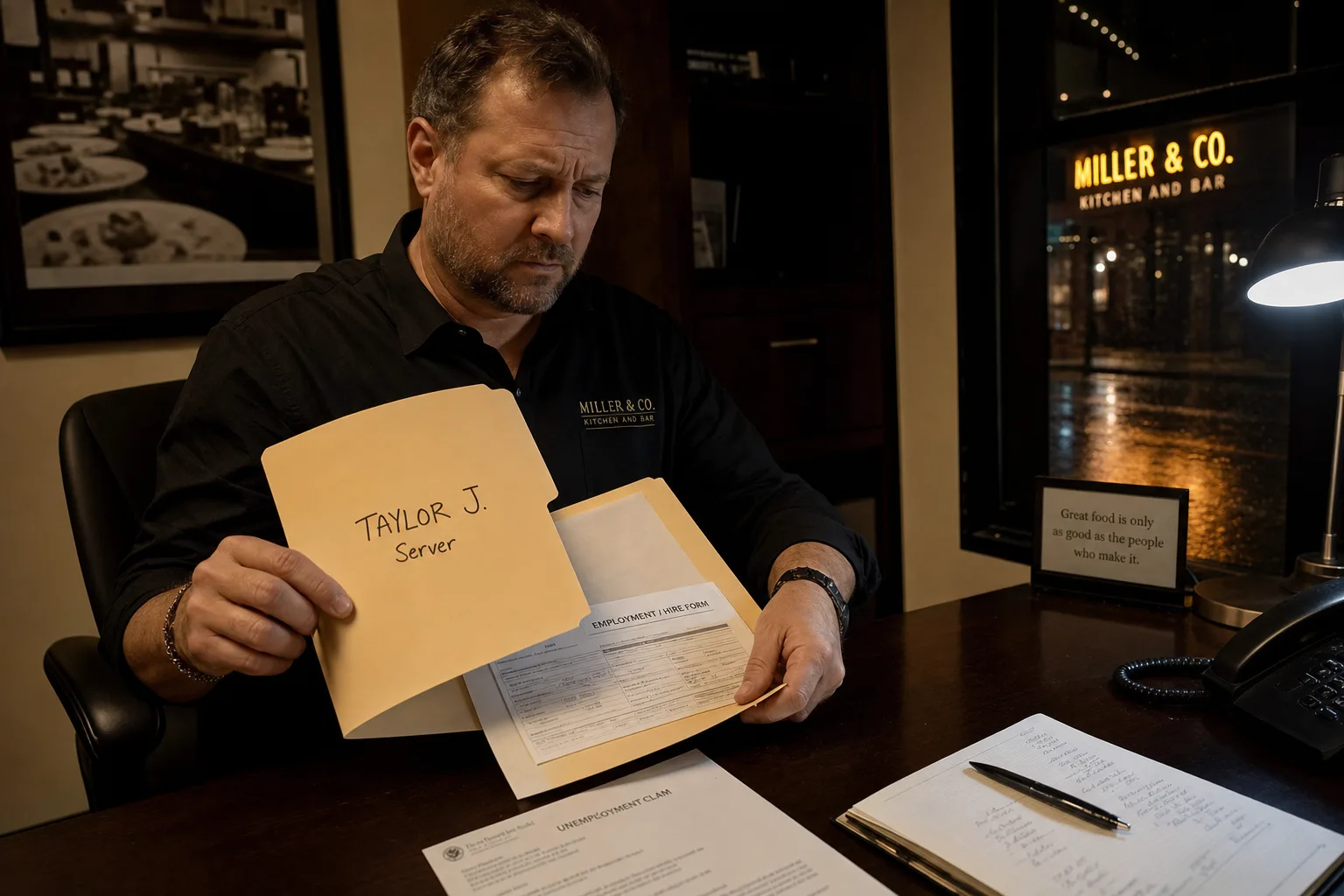
How Much Does an Unemployment Claim Cost an Employer?
Does an unemployment claim cost the employer? Yes. See the unemployment claim cost to employer—UI charges, SUTA rate hikes, and a free by-state calculator.
10 min read · September 2026
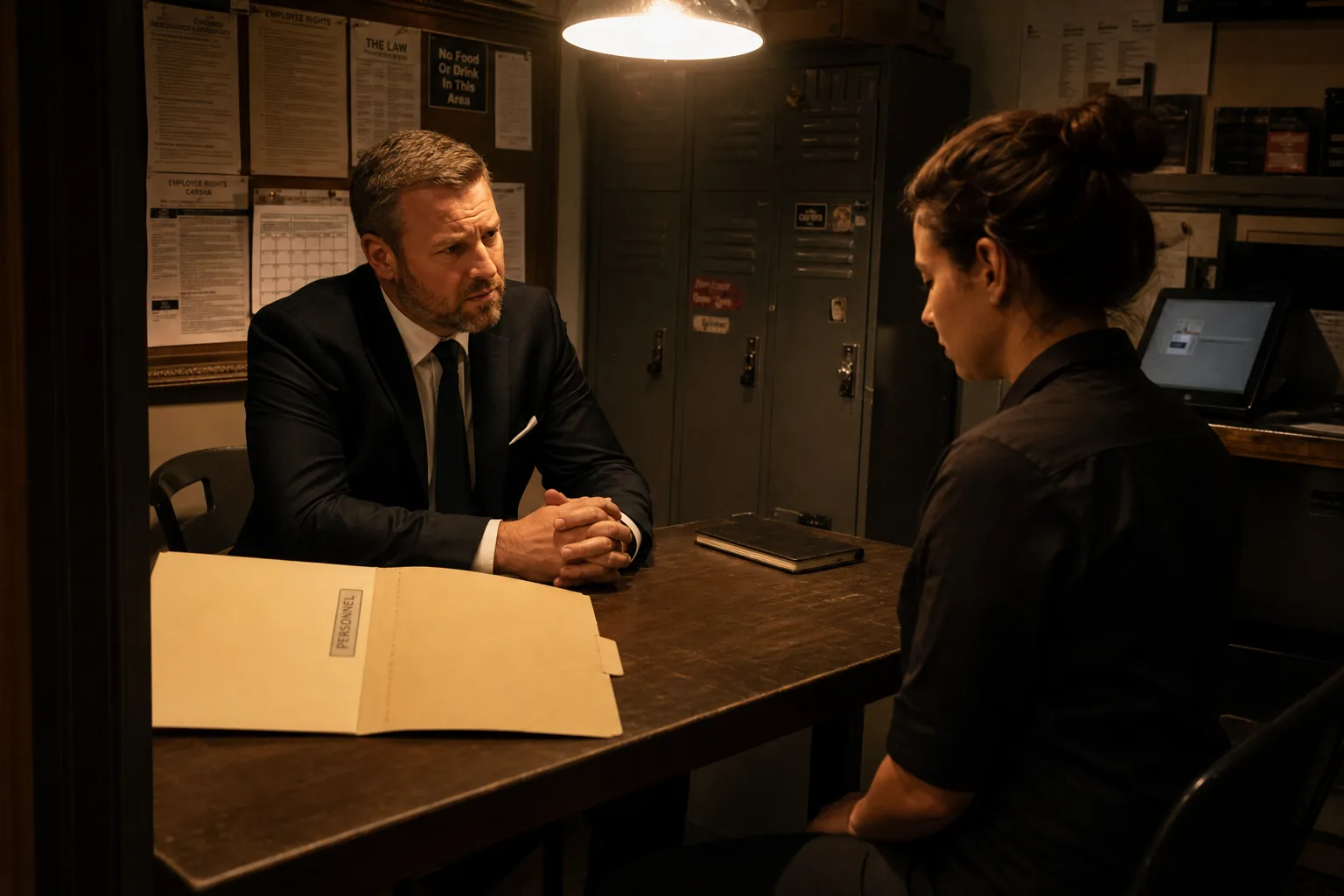
The Documentation Gap That Creates Wrongful Termination Risk
Informal warnings with no file create wrongful termination and constructive discharge exposure. Close the gap with progressive discipline that holds up.
5 min read · September 2026