Compliance & Legal
The True Cost of Missing Employee Documentation
Key takeaways
- Missing employee documentation costs restaurants real money: unemployment tax increases, legal fees, manager reconstruction hours, settlement exposure, and turnover from uneven enforcement—often five figures per badly documented separation.
- The expense rarely appears as a line item labeled "empty folder.
- " It shows up as a UI rate hike, a $8,000 demand letter, a GM spending twelve hours before a hearing, and your best server quitting because the problem coworker never got managed on paper.
- You skip documentation because the shift is on fire—not because you do not care.
- Margins are thin, labor is tight, and "write it up later" feels like the only option when the dining room is three-deep.
- The bill arrives when you can least afford distraction.
The True Cost of Missing Employee Documentation
Missing employee documentation costs restaurants real money: unemployment tax increases, legal fees, manager reconstruction hours, settlement exposure, and turnover from uneven enforcement—often five figures per badly documented separation. The expense rarely appears as a line item labeled "empty folder." It shows up as a UI rate hike, a $8,000 demand letter, a GM spending twelve hours before a hearing, and your best server quitting because the problem coworker never got managed on paper.
You skip documentation because the shift is on fire—not because you do not care. Margins are thin, labor is tight, and "write it up later" feels like the only option when the dining room is three-deep. Later never comes. The bill arrives when you can least afford distraction.

Root Cause Analysis
UI experience rating drift. Each awarded claim nudges your UI tax rate. Over three years across forty hourly employees, that is not pocket change.
Legal consult triggers. Counsel bills to reconstruct what should have been a chronological file. Empty records mean longer calls and weaker posture.
Settlement math. Plaintiff attorneys price cases on documentation gaps. A $15,000 nuisance settlement beats trial when your progressive discipline timeline does not exist.
Manager opportunity cost. At $35–$50/hour loaded GM cost, ten hours of hearing prep is $350–$500 per incident—plus the sales and coaching not done that week.
Turnover tax. Reliable employees leave when chronic problems persist undocumented. Replacement cost for hourly roles commonly runs $3,000–$10,000 when recruiting, training, and early productivity loss are included.
Multi-unit amplification. One weak store's habits inflate regional legal exposure and brand risk when a pattern of empty files surfaces in discovery.

The Actionable Framework
Cost Categories and Typical Impact Ranges
| Cost category | How missing docs trigger it | Typical impact range* |
|---|---|---|
| UI benefits awarded | Cannot prove misconduct | $3,000–$15,000+ per claim (benefits + admin) |
| Experience rating increase | Claim history | 0.5–2%+ payroll tax for 2–3 years |
| Legal consult / defense | Hearing or demand letter | $5,000–$50,000+ per dispute |
| Settlement exposure | EEOC / wrongful termination | $10,000–$100,000+ (varies widely) |
| Manager reconstruction time | Pre-hearing file build | 5–15 hours × loaded rate |
| Turnover (reliable staff) | Uneven enforcement | $3,000–$10,000+ per replacement |
| Operational drag | Repeat incidents undocumented | Guest complaints, comp tabs, overtime |
*Illustrative ranges for planning; consult counsel and your accountant for jurisdiction-specific figures.
Documentation ROI Formula (owner worksheet)
Estimated annual documentation cost =
  (UI claims lost × avg claim cost)
+ (legal hours × billing rate)
+ (manager prep hours × loaded rate)
+ (avoidable turnover × replacement cost)
Compare that total to the cost of same-shift capture tooling and 2 hours of MOD training. Most operators find one bad separation pays for a year of structure. Score the next problem file against the restaurant employee documentation checklist so you are reviewing a restaurant file, not a generic folder. Purpose-built employee documentation software is cheaper than one charged claim; how to write up an employee is the language that goes in the file. For the tax layer specifically, use the unemployment claim cost calculator and the full employer cost explainer.
Compliance note: Documentation does not guarantee you win every dispute—it reduces probability and severity. The goal is moving from "indefensible" to "counsel can work with this file."
30-Day Cost-Reduction Pilot
- Baseline — List last 6 separations: UI outcome, GM hours spent, legal touch?
- Same-shift rule — Document incidents within 2 hours; voice capture allowed.
- File audit — Score each active problem employee: coaching dates present?
- Next separation — Run pre-termination checklist before final decision.
- Review — Compare prep time and UI posture vs. baseline.
The Paper Trail and Legal Safeguard
Money follows proof. EEOC charges and demand letters ask for timelines. FLSA issues aside, wage-hour docs differ—but discipline documentation still anchors fairness narratives.
Do
- Track documentation metrics like you track food cost.
- Budget counsel review for first termination using new system.
- Train MODs that documentation is revenue protection, not paperwork.
Do not
- Assume "we are too small to get sued."
- Ignore UI losses as "cost of doing business" without root-cause review.
- Let high performers subsidize undocumented chronic problems through overtime and morale loss.
Frequently Asked Questions
How much does poor employee documentation cost restaurants?
Costs stack: lost unemployment hearings ($3k–$15k+ per claim in benefits and admin), experience rating increases, manager reconstruction time (5–15 hours per separation), legal consults ($5k–$50k+ for disputes), settlement exposure, and turnover from inconsistent enforcement.
Does one lost unemployment claim matter financially?
Yes. A single awarded claim raises experience ratings in many states, increasing UI taxes for years. Multi-unit groups feel this across hundreds of employees.
What is the hidden cost of manager time?
GMs spend hours searching texts, interviewing witnesses, and rebuilding timelines before hearings—time not spent on labor, guest experience, or sales. Empty files multiply that work.
Can missing documentation cause wrongful termination exposure?
Yes. Thin files make settlements attractive to plaintiff counsel when employees claim discrimination, retaliation, or constructive discharge without progressive discipline proof.
How does documentation affect team morale costs?
When chronic performers are not documented and separated, reliable staff pick up slack and leave—turnover costs often exceed $3k–$10k per hourly replacement.
Is documentation software worth it for a single unit?
One prevented UI loss or avoided legal consult often exceeds annual software cost. The ROI is avoiding catastrophic separations, not filing faster.
What metrics should owners track?
UI win rate, time-to-document incidents, file completeness at termination, repeat behavior before separation, and manager hours spent on hearing prep.
How quickly can documentation reduce costs?
Same-shift capture shows impact within the first separation cycle—typically 30–90 days after MOD training and one-store pilot.
Common Mistakes
- Treating documentation as HR overhead instead of P&L protection
- Calculating software cost without calculating one UI loss
- Letting problem employees stay because "firing is too much paperwork"
- Rebuilding files only after attorney engagement (maximum cost)
- Ignoring multi-store pattern data until discovery
- Skipping separation summaries to "save time"
- Using cheapest storage instead of defensible structure
Natural Solution Contextualization
The true cost of missing documentation is not the filing cabinet—it is every hour and dollar spent proving what should have been obvious when it happened. Operators who document same shift spend less on lawyers, win more UI hearings, and keep reliable crews because standards are visible on paper.
Docu-Coach™ compresses capture to ten seconds on the floor and builds the timeline HR and counsel need before costs compound. You are not buying software—you are buying fewer 11 p.m. panic sessions and fewer experience rating surprises.
Run the ROI formula on your last two separations this month. If the number makes you wince, pilot same-shift capture at one store before the next claim letter arrives.
Explore this topic
Related Resources

How Restaurants Lose Unemployment Claims Due to Poor Documentation
Restaurants lose UI claims when they cannot prove misconduct with dated records—not when they lack a lawyer. Build the documentation pack hearings require.
5 min read · September 2026
Restaurant Employee Documentation Checklist
Same-shift restaurant employee documentation checklist for FOH, BOH, attendance, alcohol, cash, and guest complaints—so a write-up or unemployment file is ready before Saturday brunch.
9 min read · September 2026
How to Defend an Unemployment Claim
How to Defend an Unemployment Claim for operators and HR. Step-by-step guidance, legal risk, examples, and best practices.
2 min read
How Much Does an Unemployment Claim Cost an Employer?
Does an unemployment claim cost the employer? Yes. See the unemployment claim cost to employer—UI charges, SUTA rate hikes, and a free by-state calculator.
10 min read · September 2026
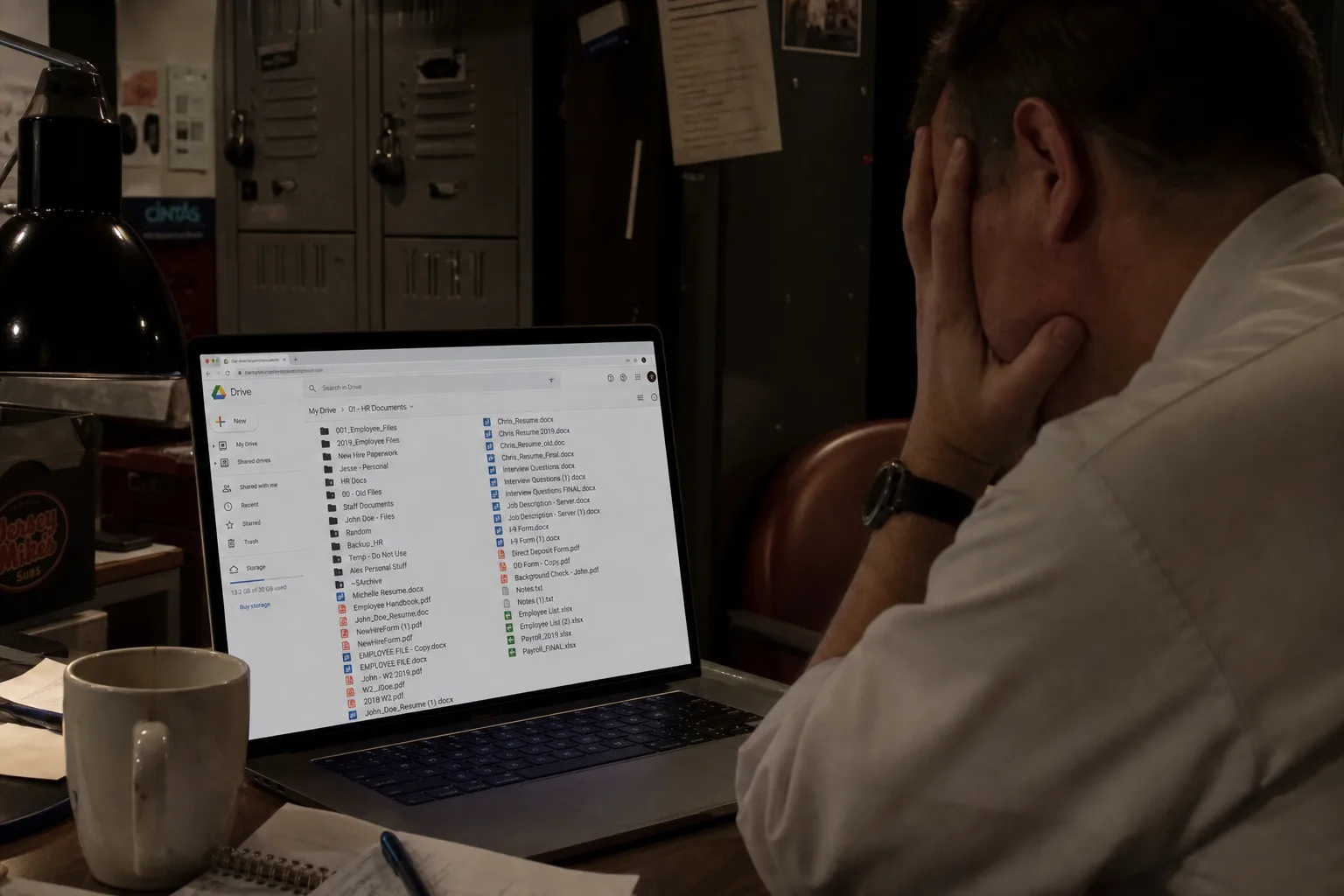
Why Google Drive Fails as an Employee Documentation System
Shared Google Drive folders are not HR systems. See why Google Drive breaks audit trails, rush capture, and unemployment defense—and what operators use instead.
6 min read · September 2026

Why Spreadsheets Are Dangerous for Employee Records
Employee tracking spreadsheets look organized until unemployment hits. Learn why editable cells, missing timestamps, and PII rows fail HR audits.
5 min read · September 2026