Compliance & Legal
How Restaurants Lose Unemployment Claims Due to Poor Documentation
Key takeaways
- Restaurants lose unemployment claims when they cannot prove misconduct or policy violation with contemporaneous, dated records—not because the termination was wrong.
- State UI (unemployment insurance) boards award benefits when the employer's story sounds credible in the breakroom but the file is empty: no write-ups, no attendance pattern, no handbook citation—just a GM saying "everyone knew he was a problem.
- Then the former employee collects benefits and your experience rating ticks up because the hearing officer never saw the paper trail you "meant" to build.
- Price the tax impact with the unemployment claim cost to employer calculator.
- Coaching that happened at the expo line but was never logged reads as fabrication when typed up after the claim.
- "Bad attitude" and "not a team player" do not map to misconduct standards.
How Restaurants Lose Unemployment Claims Due to Poor Documentation
Restaurants lose unemployment claims when they cannot prove misconduct or policy violation with contemporaneous, dated records—not because the termination was wrong. State UI (unemployment insurance) boards award benefits when the employer's story sounds credible in the breakroom but the file is empty: no write-ups, no attendance pattern, no handbook citation—just a GM saying "everyone knew he was a problem."
You terminated for cause. The team agreed. Guests complained. Then the former employee collects benefits and your experience rating ticks up because the hearing officer never saw the paper trail you "meant" to build. That is not bad luck—it is predictable when documentation lives in memory, group texts, and a drawer you never opened before the claim letter arrived. Price the tax impact with the unemployment claim cost to employer calculator.
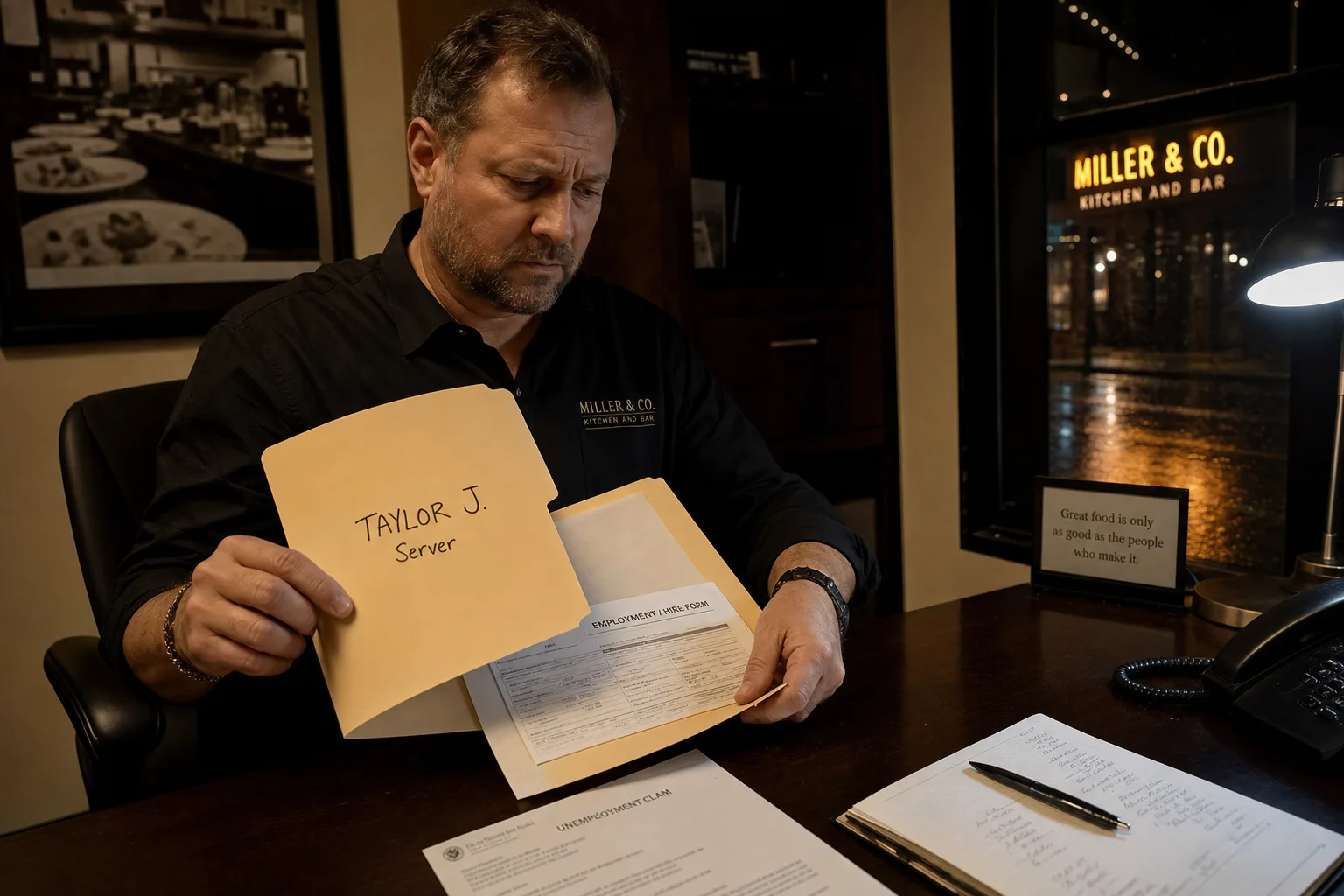
Root Cause Analysis
The contemporaneous gap. Coaching that happened at the expo line but was never logged reads as fabrication when typed up after the claim.
Vague language. "Bad attitude" and "not a team player" do not map to misconduct standards. Hearing officers want behaviors: no-show, insubordination quote, safety violation, guest complaint with date.
Missing progressive discipline. First formal write-up on the day of termination looks retaliatory unless policy allows zero-tolerance—and even then, investigation notes matter.
Attendance without pattern. One late arrival is not misconduct; three documented no-call/no-shows with coaching between them might be.
Witness vacuum. "The whole shift saw it" without names forces the state to weigh your word against the claimant's.
MOD turnover. The manager who coached Jose transferred units; the file stayed in their head.

The Actionable Framework
Hearing Response Without Docs vs. Documentation Pack
| Element | Weak response (typical loss) | Strong pack (defensible) |
|---|---|---|
| Misconduct proof | "He was always late" | Dated attendance entries: 5/12, 5/19, 6/2 with times |
| Policy basis | Verbal handbook | Signed ack + cited section in write-up |
| Progressive steps | Single termination memo | Coaching 5/14 → written 5/28 → final 6/10 |
| Behavior description | Labels ("lazy") | FACT quotes and locations |
| Employee notice | "He knew" | Documented conversations with dates |
| Separation summary | None | Who, when, reason, final pay, property return |
Same-Shift Documentation Protocol (UI-ready)
- Capture within 2 hours — Voice note or structured form on the floor.
- FACT the behavior — Who, when, where, observable action, witnesses.
- Cite policy — Handbook section or job duty violated.
- Record employee response — Their words or "declined to comment."
- File to personnel record — Not personal phone, not group chat.
- Schedule follow-up — Coaching within 24–48 hours off rush.
Pro tip: Before every termination for attendance or performance, pull the employee timeline and ask: "Could a stranger reconstruct progressive discipline from this file alone?" If not, delay separation until the record catches up—unless zero-tolerance policy and investigation support immediate action.
Pre-Termination UI Readiness Checklist
Use the full restaurant employee documentation checklist when the file is thin. For write-up language, see how to write up an employee and employee write-up examples.
| Item | Ready? |
|---|---|
| Handbook acknowledgment on file | ☐ |
| Dated coaching on same issue before write-up | ☐ |
| Write-up uses FACT language, not labels | ☐ |
| Attendance/incident logs match POS schedule | ☐ |
| Employee response or refusal documented | ☐ |
| Separation summary drafted same day | ☐ |
The Paper Trail and Legal Safeguard
UI law varies by state, but patterns hold: employers win when they show knowing violation of reasonable rules with fair notice and consistent enforcement.
Deadlines matter as much as content—response and appeal windows are short and differ by state. Restaurant unemployment claim documentation walks the page-numbered pack a hearing officer reads first and the five questions the morning usually turns on.
Do
- Document every no-call/no-show the same day with schedule proof.
- Match consequences across employees for the same behavior.
- Export a chronological pack for counsel 48 hours before the hearing.
- Include POS or scheduling exports that corroborate dates.
Do not
- Create "retroactive" coaching notes after the claim arrives.
- Rely on text threads without formal file entries.
- Terminate for "policy violation" you cannot cite by section.
- Send a manager to the hearing without the actual file—they will improvise under oath.
| Documentation gap | Typical hearing outcome |
|---|---|
| Empty file, credible employee | Benefits awarded |
| Pattern + coaching + write-ups | Benefits denied (misconduct) |
| Single vague write-up | Mixed—often employer loss |
| Zero-tolerance with investigation notes | Stronger employer position |
Frequently Asked Questions
Why do restaurants lose unemployment claims they should win?
Most losses are documentation failures, not legal ones. Without contemporaneous records proving misconduct or policy violation, the state UI board defaults to awarding benefits—even when the termination was fair.
What is misconduct for unemployment purposes?
Standards vary by state, but generally the employer must show the employee knew expectations, violated policy, and often received prior warning—supported by dated records, not manager memory.
What documents do I need for an unemployment hearing?
Handbook acknowledgment, dated coaching and write-ups, attendance logs, incident reports with witnesses, separation summary, and proof the employee received progressive discipline where required.
How soon should incidents be documented for UI defense?
Same shift, ideally within 2 hours. Hearing officers distrust entries created after the claim is filed or after termination.
Does a signed write-up guarantee we win?
No, but unsigned or undated files hurt badly. You need FACT-based facts, policy citations, prior steps in the chain, and employee response or documented refusal to sign.
Can verbal warnings count?
Only if documented contemporaneously with date, topic, and manager name. 'We talked plenty of times' without records rarely wins.
What if the employee no-showed?
Document each no-call/no-show same day, cite attendance policy, show prior coaching on the pattern, and provide schedule records from your POS or scheduling system.
How does Docu-Coach™ help with unemployment defense?
It creates timestamped incident and coaching entries on the floor, builds progressive discipline timelines automatically, and exports employee history for hearing prep.
Common Mistakes
- Assuming "at-will" means you do not need records for UI
- Coaching in public but never logging private follow-up
- Using group texts as the system of record
- Firing on Friday without same-day separation documentation
- Letting each store define "misconduct" differently
- Skipping witness names to avoid drama
- Waiting for HR to "build the file" after the claim
Natural Solution Contextualization
Unemployment hearings are not trials of your leadership—they are audits of your records. The operator who wins is often not the one who managed better; it is the one who documented same shift while still running a profitable Friday night.
Docu-Coach™ turns floor captures into timestamped entries on a progressive timeline—so when the claim letter hits, you export Jose's attendance coaching chain in minutes instead of reconstructing six months from memory and screenshots.
Run the pre-termination checklist on your next separation candidate this week. If more than two boxes are empty, coach and document before you separate—or accept the UI tax as a line item you chose not to prevent.
Explore this topic
Related Resources
How to Defend an Unemployment Claim
How to Defend an Unemployment Claim for operators and HR. Step-by-step guidance, legal risk, examples, and best practices.
2 min read
Restaurant Employee Documentation Checklist
Same-shift restaurant employee documentation checklist for FOH, BOH, attendance, alcohol, cash, and guest complaints—so a write-up or unemployment file is ready before Saturday brunch.
9 min read · September 2026
How to Write Up an Employee
How to Write Up an Employee for operators and HR. Step-by-step guidance, legal risk, examples, and best practices.
3 min read
Employee Write-Up Examples
Employee Write-Up Examples for operators and HR. Step-by-step guidance, legal risk, examples, and best practices.
3 min read
How Much Does an Unemployment Claim Cost an Employer?
Does an unemployment claim cost the employer? Yes. See the unemployment claim cost to employer—UI charges, SUTA rate hikes, and a free by-state calculator.
10 min read · September 2026
How to Build a Defensible Employee Record
A defensible employee record needs five record types, FACT language, and progressive discipline—not a full drawer. Build audit-ready files operators use.
4 min read · September 2026