HR & Labor Compliance
How to Write Up a Restaurant Employee Legally: FACT Method and Defensible Templates
Key takeaways
- Legally sound restaurant write-ups use the FACT method—Factual observation, Action/policy, Context, and Target/consequence—replacing emotion labels like "bad attitude" with observable behaviors a witness could confirm.
- Unemployment boards, the EEOC, and plaintiff counsel all ask the same question: what did the employee actually do, when, and under which policy?
- Your fingers type what your blood pressure feels: “Employee was disrespectful and has a bad attitude toward management.
- ” You print it, have them sign, and move on.
- Three months later, that sentence is the only thing HR remembers.
- “Disrespectful” is your interpretation unless you quote specific words and describe context.
How to Write Up a Restaurant Employee Legally
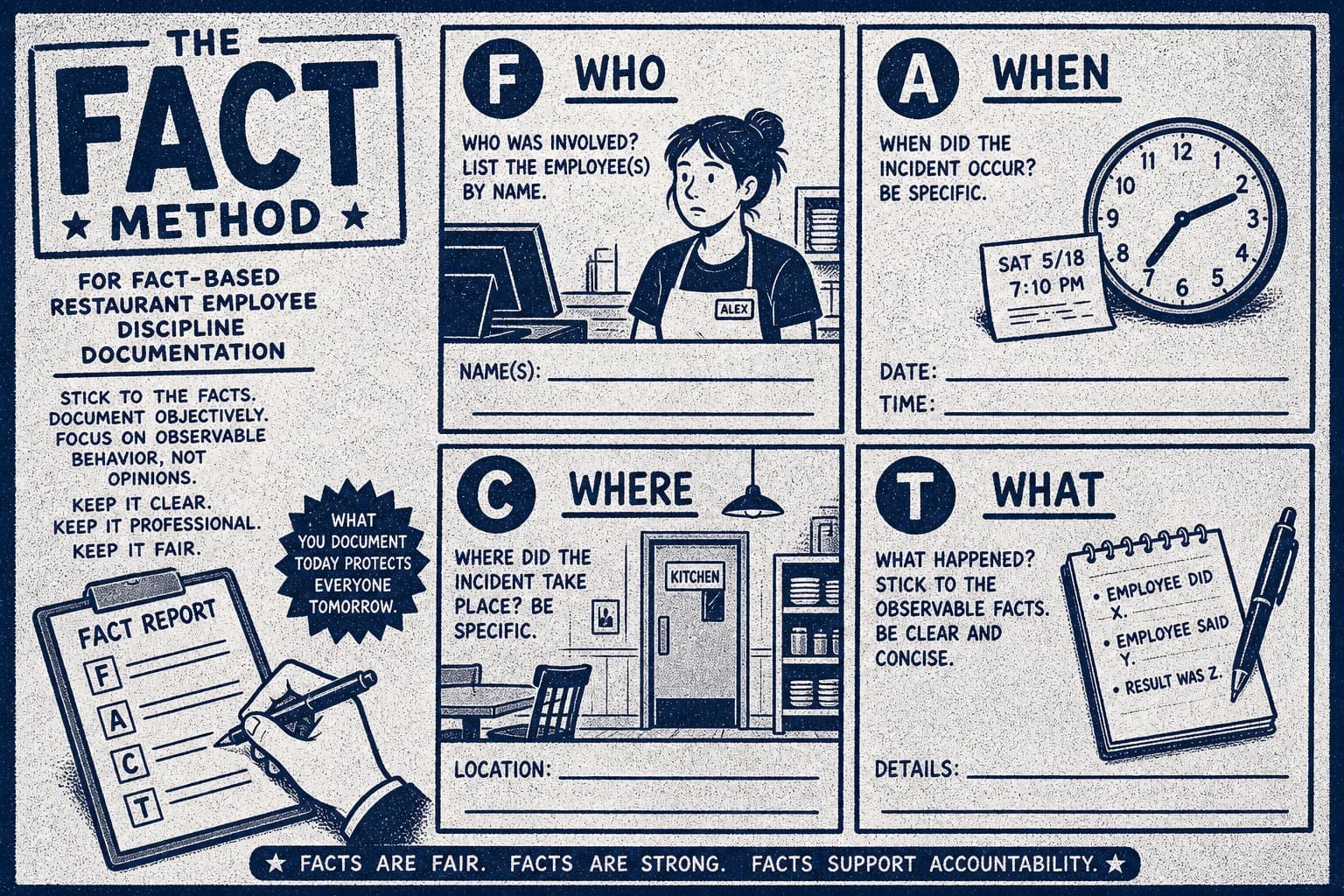
Legally sound restaurant write-ups use the FACT method—Factual observation, Action/policy, Context, and Target/consequence—replacing emotion labels like "bad attitude" with observable behaviors a witness could confirm. Unemployment boards, the EEOC, and plaintiff counsel all ask the same question: what did the employee actually do, when, and under which policy?
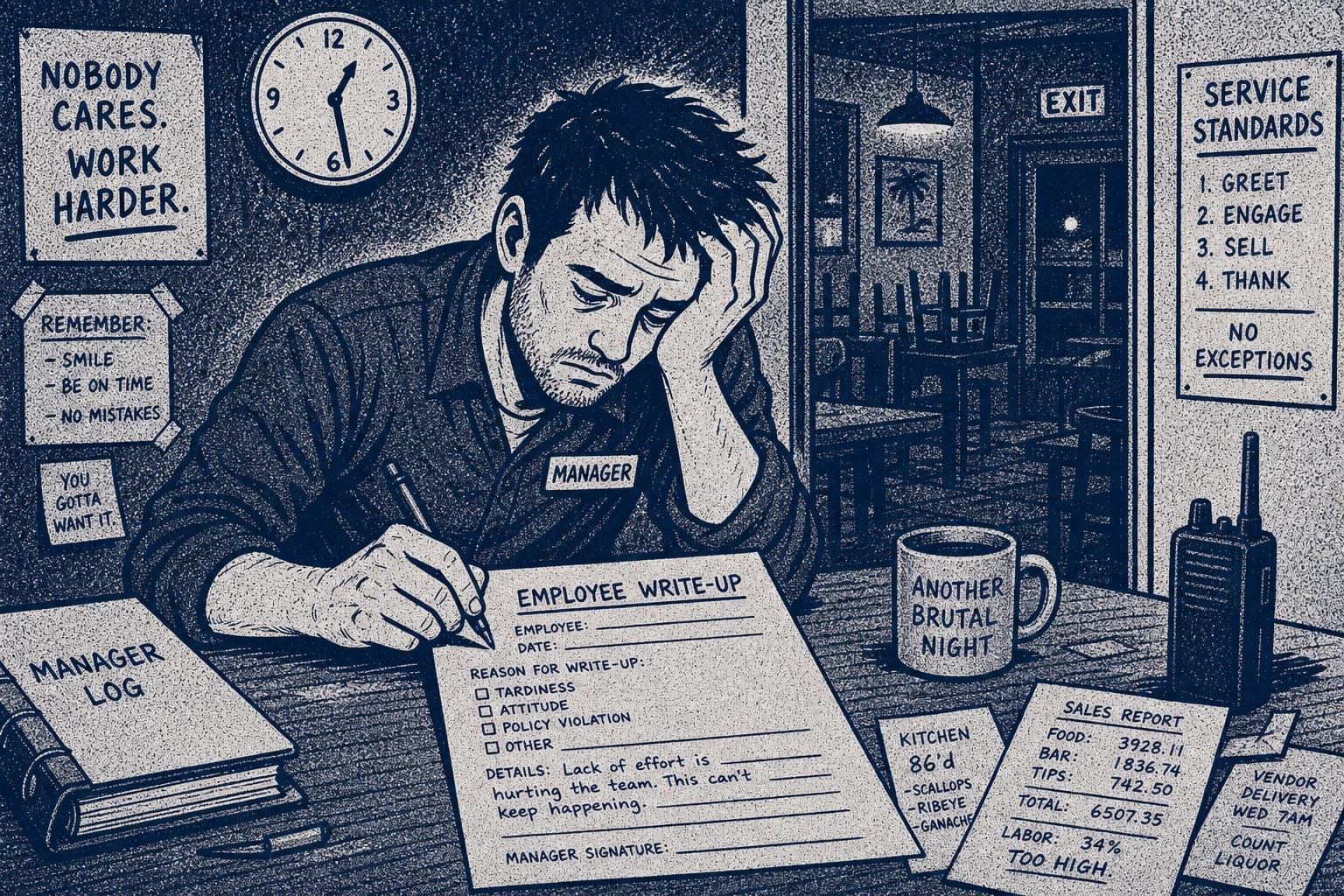
You are drafting a write-up at 10 p.m. after a brutal shift. Your fingers type what your blood pressure feels: “Employee was disrespectful and has a bad attitude toward management.” You print it, have them sign, and move on. Three months later, that sentence is the only thing HR remembers.
“Attitude” is not a behavior. “Disrespectful” is your interpretation unless you quote specific words and describe context. Legally sound restaurant write-ups are boring on purpose. They read like a security camera recap: who, when, where, what was seen and heard, which policy applies, what happens next.
This article teaches the FACT method, an emotion-stripping table for common MOD language, and the write-up structure Docu-Coach™ generates from your entries. You will still lead with humanity; the paper will lead with facts.
Root Cause Analysis
Emotion-first documentation. Rush, betrayal, or exhaustion push managers to vent on paper. Courts and agencies read venting as bias or vagueness.
Skipping the coaching step. A first write-up with no prior documented conversation looks punitive, not progressive—unless policy is zero-tolerance.
Inconsistent policy citation. One employee gets written up for “uniform”; another gets a verbal for the same. Inconsistency is evidence in discrimination cases.
Wrong level of detail. Too vague (“not a team player”) or too personal (“always drama with her boyfriend”) creates legal exposure and unprofessional files.
No employee response captured. A write-up without “employee stated…” looks one-sided. You need their account—or “refused to respond.”
Handbook mismatch. Discipline for behavior your handbook does not cover, or consequences not listed in your matrix, gets reversed.
Legal write-ups are not about winning fights with employees. They are about clarity, consistency, and contemporaneous facts so you can coach, correct, or separate with defensible records.
The Actionable Framework
FACT Method (every write-up section)
| Letter | Meaning | Manager question |
|---|---|---|
| F | Factual observation | What would a witness say they saw/heard? |
| A | Action / policy | Which handbook rule or job expectation was violated? |
| C | Context (minimal) | Relevant only: prior coaching same issue? guest present? |
| T | Target / consequence | What must change; what happens if it does not (per handbook tier) |
Draft in FACT order in Docu-Coach™ before saving the corrective action. If you cannot complete F in two sentences, you are not ready to write.
The restaurant employee write-up guide adds the fields around the narrative—prior steps with their dates, the action level, the follow-up date—and how to deliver the document off the floor.
Compliance warning: "Attitude" is not a behavior. If your write-up's factual section names a feeling instead of an action, stop and rewrite before anyone signs.
Emotion Stripping Table (replace before you save in Docu-Coach™)
| Instead of (emotion / label) | Write (observable FACT) |
|---|---|
| Bad attitude | “When asked to run food to table 12, said ‘that’s not my section’ and did not move until second request” |
| Disrespectful | “In BOH at 8:15 p.m., raised voice and said [quote] to MOD in presence of cook [name]” |
| Lazy / not a team player | “Left sidework station at 9:00 p.m. with checklist 4 items incomplete; walked to locker” |
| Unprofessional | “Guest at bar commented to MOD that employee used profanity while describing special” |
| Doesn’t care | “No-call no-show for scheduled shift 6/3; no call to store by 30 min after start per policy” |
| Drama / toxic | Document specific incidents on separate dated entries; avoid personality diagnoses |
| Always late | “Late 6/1, 6/4, 6/7 by 12+ minutes; Docu-Coach™ attendance entries on file” |
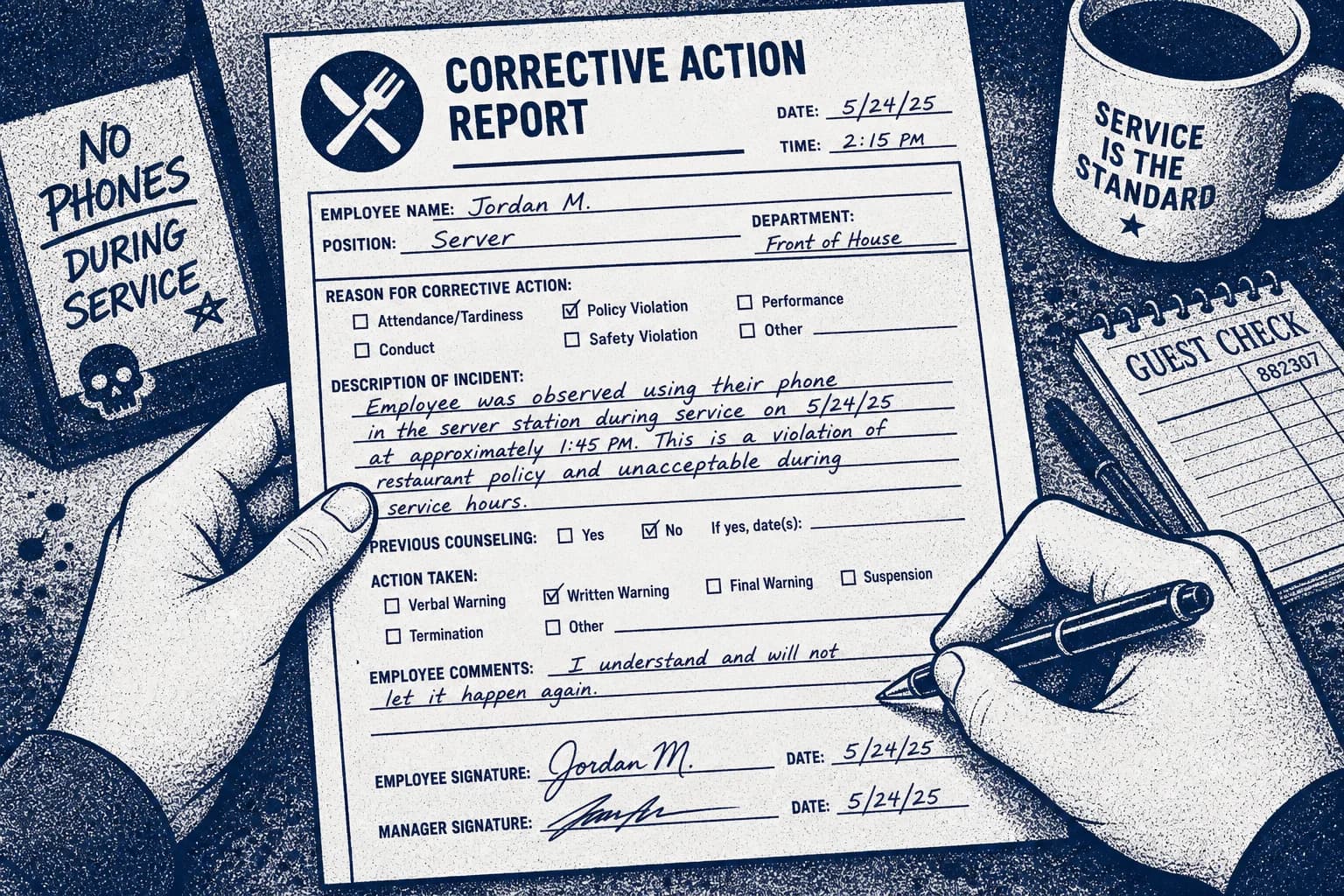
Write-Up Template (formal corrective action — Docu-Coach™ generates this structure)
CORRECTIVE ACTION / WRITTEN WARNING
Store: _____________  Date: _____________
Employee: _________________________  ID/Role: _________________________
Manager: _________________________  Title: _________________________

PRIOR DOCUMENTATION (if any):
[ ] Verbal coaching on [date] re: [topic] — see Docu-Coach™ entry
[ ] Previous written warning on [date] re: [topic]
[ ] First formal corrective action for this issue

1. FACTUAL OBSERVATION (F)
On [date] at approximately [time] at [location], I observed / the following occurred:
[Describe behavior in neutral language. Use quotes for exact words. Name witnesses.]

Employee’s account (summarize): _______________________________________
or: Employee declined to provide statement / refused to sign (witness: ______).

2. ACTION / POLICY (A)
This conduct violates the following expectation(s):
[ ] Handbook Section ___ : [title]
[ ] Job description duty: [e.g., sidework, alcohol service, safety]
[ ] Prior communicated standard: [meeting/date]

3. CONTEXT (C) — only if relevant
[Prior coaching same issue / guest impact / safety risk — brief.]

4. TARGET / CONSEQUENCE (T)
Required correction: By [date], employee must [measurable behavior].
Failure to sustain improvement may result in [next step per handbook: final warning, suspension, termination].

Employee signature: _________________________  Date: _______
Manager signature: _________________________  Date: _______
Witness (if refused to sign): _________________________  Date: _______

Copy: Employee personnel file in Docu-Coach™. Original policy: employee may refuse to sign; refusal noted.
Coaching Dialogue (hold before or with write-up; private, off floor)
Use this script to reduce surprise and capture response for the file.
COACHING DIALOGUE — CORRECTIVE CONVERSATION

OPEN
“Thanks for meeting. I need to discuss what happened on [date] during [shift]. This is serious and I want your side.”

FACTS (no debate on feelings)
“At [time] in [location], I observed / was reported: [FACT]. Witnesses include [names] if applicable.”

POLICY
“Our expectation per [handbook section] is [clear standard].”

THEIR ACCOUNT (listen once; do not argue in circles)
“What happened from your perspective?”
[Pause. Note key points for documentation.]

EXPECTATION + CONSEQUENCE
“Going forward, I need [specific behavior]. I’m documenting this conversation [and issuing a written warning per our process]. Next step if this continues is [per handbook].”

CLOSE
“Do you understand what I’m asking you to change? Any questions on the standard itself?”
[If write-up: present Docu-Coach™-generated document; allow read; signatures or refused with witness.]

POST (manager, same shift)
Confirm the entry is filed: date, time, who present, FACT summary, employee response one sentence, next follow-up date. Docu-Coach™ auto-generates this log from your corrective action entry—no separate step needed.
Progressive Discipline Alignment
Match your handbook tiers. Typical restaurant sequence:
- Verbal coaching (documented same day)
- Written warning (FACT write-up)
- Final written warning / suspension
- Termination
Zero-tolerance items (theft, violence, serious harassment, intoxication on job) may skip steps—if handbook says so and investigation is complete.
Frequently Asked Questions
How do you write up a restaurant employee legally?
Use the FACT method: Factual observation, Action/policy violated, minimal Context, and Target/consequence. Replace labels like 'bad attitude' with observable behaviors, quotes, and handbook citations.
What is the FACT method for write-ups?
F = what a witness saw/heard; A = handbook section violated; C = relevant prior coaching or guest impact; T = measurable correction and next discipline step per policy.
Is 'bad attitude' acceptable in a write-up?
No. Attitude is not a behavior. Courts and UI boards require specific actions, times, locations, and quotes—not personality labels.
Does an employee have to sign a write-up?
They may refuse. Document refusal with a witness present; the entry still belongs in the personnel file.
When should coaching happen relative to a write-up?
Hold a private coaching conversation within 24–48 hours, capture the employee's account, then issue the formal corrective action with progressive discipline alignment.
What progressive discipline steps apply in restaurants?
Typically documented verbal coaching, written warning, final warning/suspension, then termination—unless zero-tolerance policy and investigation support immediate separation.
Can Docu-Coach™ generate legal write-up language?
Yes. It structures entries around FACT fields and policy tags so managers produce consistent corrective-action language for HR review.
How do I get started with Docu-Coach™ for write-ups?
Book a demo at docu-coach.com/demo or email hello@docu-coach.com for a 30-day trial walkthrough.
The Paper Trail and Legal Safeguard
A legally sound write-up is one node in a chain. HR and counsel want to see progression, not a single dramatic memo.
Do
- Use FACT language; cite handbook sections by number and title.
- Document employee’s statement or refusal.
- File to the official personnel record immediately—Docu-Coach™ does this on save.
- Apply the same consequence for the same behavior across employees and shifts.
- Separate medical/religious issues to HR; do not diagnose or speculate on disability.
Do not
- Threaten consequences not in the handbook (“you’re done” without process).
- Include race, gender, age, religion, pregnancy, or national origin commentary—ever.
- Promise “this will stay between us” if you are creating a file record.
- Backdate or alter entries; correct with a new dated addendum if error found.
| Risk | Safer practice |
|---|---|
| Single “attitude” write-up | Multiple dated FACT entries on specific behaviors |
| Public signing at the line | Private office or quiet BOH |
| No witness on refused signature | Second manager present |
| Vague improvement (“do better”) | Measurable target (“complete sidework checklist before clock-out”) |
When unemployment challenges the separation, the write-up’s F section is your anchor. Emotion-free facts age well; adjectives do not.
Natural Solution Contextualization
Learning to write up a restaurant employee legally is a skill shift: from “how I felt about the shift” to “what a camera would show.” The FACT method and templates above are what good GMs use before they ever talk to counsel—because the file already sounds like counsel wrote it.
Docu-Coach™ structures every entry around observable fields and policy tags, so “bad attitude” gets harder to save and FACT-style summaries become the default. Managers capture incidents on the floor, then generate consistent corrective-action language for HR review—same format, every store, every MOD.
Bookmark the emotion-stripping table. Run the coaching conversation within 48 hours of the incident. Your write-ups will be shorter, colder on adjectives, and far stronger when it matters. For the process and sample language, see how to write up an employee and employee write-up examples.
Explore this topic
Related Resources
How to Write Up an Employee
How to Write Up an Employee for operators and HR. Step-by-step guidance, legal risk, examples, and best practices.
3 min read
Employee Write-Up Examples
Employee Write-Up Examples for operators and HR. Step-by-step guidance, legal risk, examples, and best practices.
3 min read
Restaurant Employee Documentation Checklist
Same-shift restaurant employee documentation checklist for FOH, BOH, attendance, alcohol, cash, and guest complaints—so a write-up or unemployment file is ready before Saturday brunch.
9 min read · September 2026
How to Defend an Unemployment Claim
How to Defend an Unemployment Claim for operators and HR. Step-by-step guidance, legal risk, examples, and best practices.
2 min read
Restaurant Employee Write-Up
How to write up a restaurant employee: the fields a defensible write-up needs, FACT language instead of labels, examples by incident type, and how to deliver it on a busy shift.
7 min read · September 2026
Chronic Attendance in Restaurants: Pattern Coach Plan Protocol and PIP That Holds Up
Third no-call this month? Use the Pattern Coach Plan for chronic restaurant attendance—coaching script, PIP outline, and morale rules that protect the team.
8 min read · September 2026