HR & Labor Compliance
Restaurant Employee HR Documentation System: From Scattered Notes to Audit-Ready Files
Key takeaways
- A restaurant employee HR documentation system is a single standard for five record types—incident, coaching, recognition, attendance, and HR/legal—captured same shift with required fields and reviewed monthly across locations.
- You pull an employee file before a termination conversation.
- Inside: a signed handbook from hire day, maybe a food handler card, and three years of silence.
- The MOD who “handled it on the floor” is now at another store—or gone entirely.
- At the unemployment hearing, the former employee says they were blindsided.
- Your attorney asks for progressive discipline.
Restaurant Employee HR Documentation System: Unified Standard
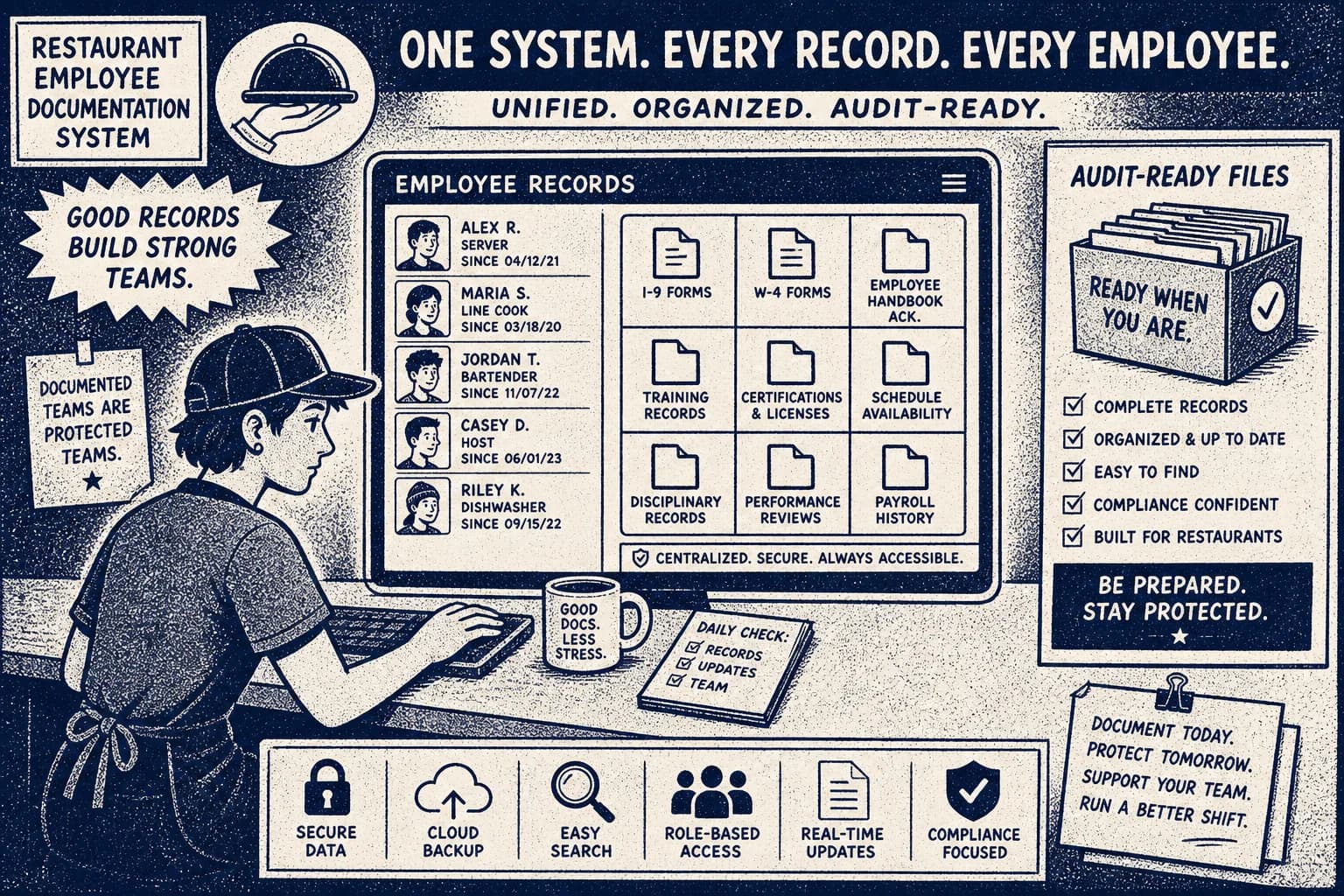
A restaurant employee HR documentation system is a single standard for five record types—incident, coaching, recognition, attendance, and HR/legal—captured same shift with required fields and reviewed monthly across locations. It is not software alone; it is what gets logged, when, where it lives, and who audits it.
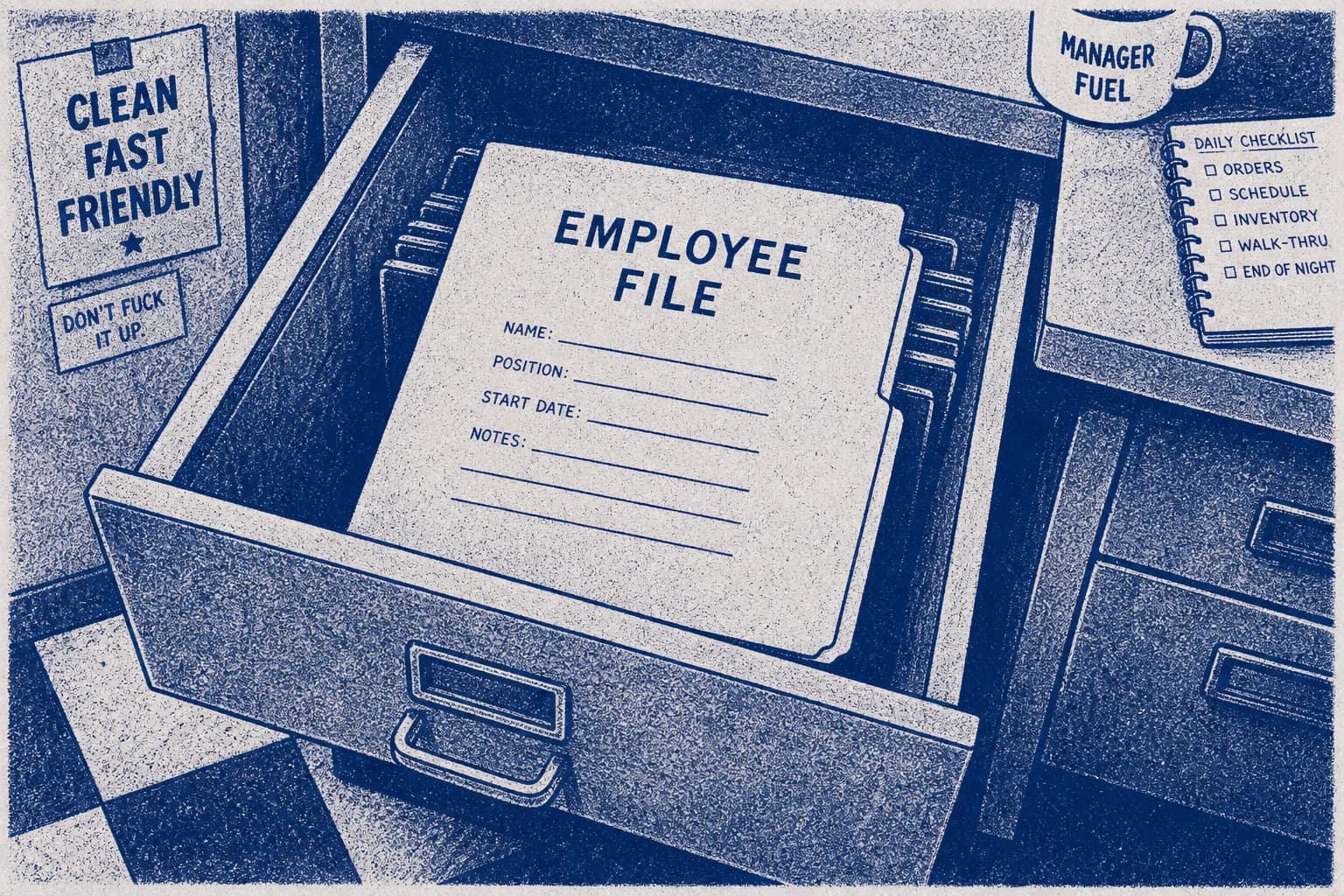
You pull an employee file before a termination conversation. Inside: a signed handbook from hire day, maybe a food handler card, and three years of silence. No coaching notes. No attendance pattern. No guest complaint follow-ups. The MOD who “handled it on the floor” is now at another store—or gone entirely.
At the unemployment hearing, the former employee says they were blindsided. Your attorney asks for progressive discipline. You have stories, not records. The claim costs more than the separation check would have, and your DOO asks why Store 4 always loses documentation battles.
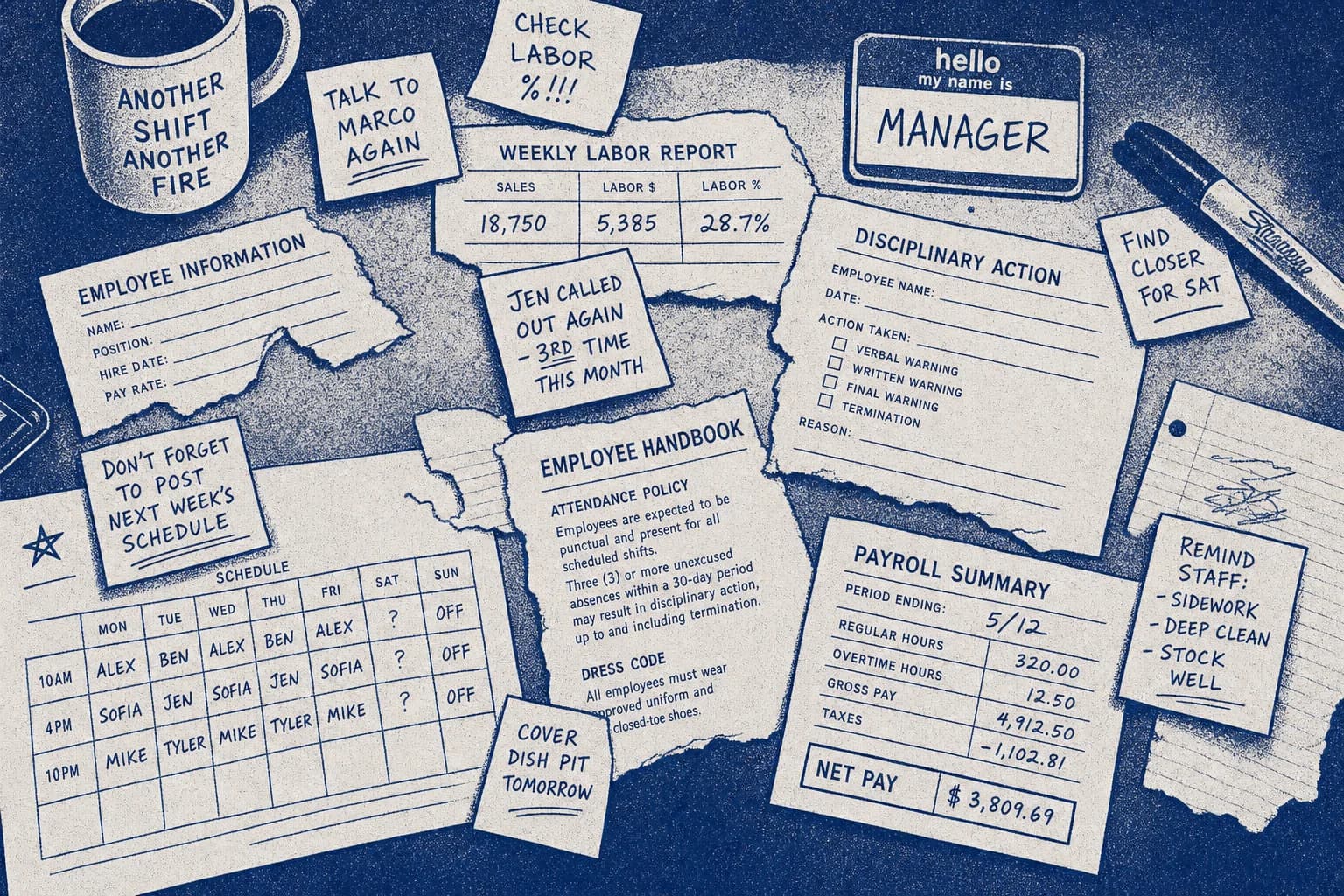
Scattered documentation is operational risk. Multi-location groups amplify it: each GM invents a system (group texts, email drafts, shared drives, paper in a drawer). HR cannot roll up trends because data never existed in one shape. This article defines the unified standard; the restaurant employee documentation checklist turns it into a same-shift operating routine.
Root Cause Analysis
Hero-manager dependency. Documentation quality tracks with whoever is on duty. Strong MODs log; tired MODs “will do it tomorrow.” Without a mandatory minimum, the system collapses on busy weekends.
Wrong tool fragmentation. Incidents in texts, compliments in email, write-ups in print, attendance in the POS export nobody downloads. HR spends hours reconstructing timelines.
No definition of “documentable.” Teams wait for termination-level events. By then, missing early notes make every final conversation look like sudden punishment.
Lack of roll-up architecture. Area directors cannot compare stores if Store A uses Google Docs and Store B uses a binder. You cannot fix culture you cannot measure.
Training gap. New managers know how to 86 an item; they were never taught what belongs in a file, tone, or retention.
Fear and speed. Documenting feels like building a case against people you eat family meal with. In reality, documentation protects fair employees too—it shows who was coached, who improved, and who was given chances.
The fix is a unified documentation standard: same categories, same fields, same timing, same review cadence—then tools that make compliance easier than avoidance.
The Actionable Framework
Unified Documentation Standard (what every store logs)
Adopt these five record types for every location. If it is not one of these, it does not belong in the official file.
| Type | Trigger | Timing | Stored as |
|---|---|---|---|
| Incident / behavior | Policy violation, guest impact, safety, interpersonal conflict | Same shift via Docu-Coach™ voice capture; summary auto-generated ≤24 hr | Dated entry + witnesses |
| Coaching / expectation | Performance gap, skill, attendance conversation | Within 48 hr of conversation | Signed or acknowledged note |
| Positive recognition | Above-and-beyond, recovery save, leadership | Weekly or as earned | Short dated entry |
| Attendance / schedule | No-call, late pattern, leave request outcome | Per occurrence + pattern summary monthly | Dates, times, policy cited |
| HR / legal | Harassment, injury, accommodation, investigation | Immediate per policy | HR-owned, restricted access |
Field standard for every entry (captured in Docu-Coach™): Date, time, location, manager name, employee legal name, observable facts, policy reference (handbook section), action taken, follow-up date, attachments (guest email, photo if policy allows).
Pro tip: Consistency across locations defeats discrimination claims. When Store 2 fires for tardiness and Store 5 promotes through it, counsel cannot show policy-based decisions—unified record types fix that.
Employee File Checklist (open or audit any file in 10 minutes)
RESTAURANT EMPLOYEE FILE — AUDIT CHECKLIST
Store #: ______  Employee: ______________________  Role: ____________
Reviewer: _________________  Date: ______________

A. HIRE & COMPLIANCE
[ ] Application / offer (or HRIS export)
[ ] Handbook acknowledgment (dated)
[ ] Required certifications (food handler, alcohol if applicable)
[ ] I-9 / work authorization (HR only — do not duplicate in store binder)

B. ACTIVE DOCUMENTATION (last 12 months)
[ ] At least one performance touchpoint (coaching or recognition) if tenure > 90 days
[ ] All incidents logged in Docu-Coach™ within 24 hours of event
[ ] Attendance pattern summary if ≥3 occurrences same issue
[ ] Guest complaints involving employee with manager follow-up noted

C. DISCIPLINE PROGRESSION (if applicable)
[ ] Verbal coaching documented before written warning (unless zero-tolerance policy)
[ ] Written warnings dated, signed or “refused to sign” noted with witness
[ ] Improvement plan with measurable goals and review dates
[ ] Consistent policy citations across entries (same section numbers)

D. MANAGER QUALITY
[ ] Facts vs. opinions (behavior verbs, not labels)
[ ] Witnesses named where others present
[ ] No protected-class commentary; no medical diagnosis language
[ ] Entries in chronological order; no unexplained gaps > 6 months for active staff

E. MULTI-LOCATION ROLL-UP (DO / HR monthly)
[ ] Docu-Coach™ export: incidents by category, store, repeat names
[ ] Stores below minimum documentation rate flagged for GM coaching
[ ] Terminations in last 30 days: file complete before final pay

FAIL any zero-tolerance gap (harassment, violence, theft) → stop; escalate to HR before further manager action.
Implementation Rollout (90 days)
Days 1–30: Publish the five record types and field standard. Retire unofficial channels for discipline (no write-ups in personal texts). Train MODs on Docu-Coach™'s 10-second floor capture—summary auto-generated same shift.
Days 31–60: Pilot one area with weekly file spot-checks (two random files per store). Score with the checklist; coach GMs on gaps, not shame.
Days 61–90: Multi-location roll-up meeting: incident counts, repeat behaviors, stores with zero coaching notes. Tie documentation completion to GM goals—not as bureaucracy, as “we can defend and develop our people.”
Multi-Location Roll-Up Dashboard (minimum viable)
HR or the DOO should review a monthly roll-up covering these five data points—Docu-Coach™ exports them by store and date range, no manual assembly required:
- Incidents by store (count and top three categories)
- Employees with 3+ incidents in 90 days (names to area director only)
- Open follow-ups past due (conversation not held)
- Terminations and “file complete Y/N” before separation
- Training hours on documentation standard by store
Patterns you will catch early: one MOD never logs; one store documents only favorites negatively; attendance issues clustered on one shift lead.
Manager Rituals That Make the System Stick
- Weekly: 15-minute documentation review in manager meeting—one real (redacted) example of good vs. weak entry.
- Per shift: Confirm all incidents are logged before the next manager's shift begins—Docu-Coach™ surfaces open entries during shift handoff so nothing falls through.
- Per termination: HR or GM sign-off that checklist section C is satisfied.
Frequently Asked Questions
What is a restaurant employee HR documentation system?
A unified standard for five record types—incident, coaching, recognition, attendance, and HR/legal—with required fields, same-shift capture timing, and multi-unit roll-up review. It is policy plus tooling, not software alone.
What are the five record types every store should log?
Incident/behavior, coaching/expectation, positive recognition, attendance/schedule, and HR/legal (restricted access). Each has defined triggers and timing.
How quickly should managers file documentation?
Incidents same shift via voice capture; coaching within 48 hours of conversation; attendance per occurrence; HR/legal items immediately per policy.
What belongs on the employee file audit checklist?
Hire/compliance docs, active documentation in last 12 months, discipline progression if applicable, manager quality (FACT language), and multi-location roll-up flags.
How do multi-unit groups roll up documentation?
Monthly review of incidents by store, repeat-behavior names, overdue follow-ups, termination file completeness, and training hours—exported from a unified system like Docu-Coach™.
Does this replace payroll or HRIS?
No. Documentation is the incident/coaching layer complementing payroll, benefits, and core HR data.
Why do empty files create legal risk?
Unemployment and EEOC reviewers cannot verify progressive discipline, consistent standards, or fair notice when files contain only hire paperwork.
How do I implement a documentation system in 90 days?
Publish five record types (days 1–30), pilot with weekly spot-checks (31–60), then roll up metrics region-wide (61–90). Docu-Coach™ 30-day free trials at docu-coach.com/demo.
The Paper Trail and Legal Safeguard
An audit-ready file does not mean voluminous. It means complete for the story you need to tell: hire → expectations → documented gaps → coaching → consequences.
Unemployment and litigation reviewers ask: Did the employee know the rule? Was the rule enforced consistently? Was the employee given a chance to correct? Your system proves attempt, not perfection.
Retention: Follow your counsel’s guidance; typically 3–7 years post-separation for employment records. Docu-Coach™ serves as the system of record—avoid discipline notes only on the GM’s phone or in personal texts.
Consistency across locations defeats discrimination claims (“Store 2 fires for this, Store 5 promotes”). Unified standards let you show policy-based decisions.
Restricted access: Harassment and medical accommodation live in HR-controlled files; floor managers get need-to-know summaries only.
When files are empty, you are not “being nice.” You are leaving managers and employees unprotected. A unified system is how multi-unit groups act like one company instead of a collection of shift heroes.
Natural Solution Contextualization
Building a restaurant employee HR documentation system is half policy, half friction removal. The checklist above is the policy spine; the roll-up meeting is how you enforce it without living in every store’s back office.
Docu-Coach™ gives each location the same capture flow—incident, coaching, attendance—in one chronological employee timeline, with timestamps and structured fields that match what HR and counsel expect. Area directors get exportable history without chasing screenshots, and GMs document on the floor in seconds instead of skipping it for “after close” that never comes.
Start with the five record types and the audit checklist on your next manager call. Empty files are a choice once the standard exists; the system makes the right choice the easy one.
Explore this topic
Related Resources
Restaurant Employee Documentation Checklist
Same-shift restaurant employee documentation checklist for FOH, BOH, attendance, alcohol, cash, and guest complaints—so a write-up or unemployment file is ready before Saturday brunch.
9 min read · September 2026
How to Write Up an Employee
How to Write Up an Employee for operators and HR. Step-by-step guidance, legal risk, examples, and best practices.
3 min read
Employee Write-Up Examples
Employee Write-Up Examples for operators and HR. Step-by-step guidance, legal risk, examples, and best practices.
3 min read
How to Defend an Unemployment Claim
How to Defend an Unemployment Claim for operators and HR. Step-by-step guidance, legal risk, examples, and best practices.
2 min read
Chronic Attendance in Restaurants: Pattern Coach Plan Protocol and PIP That Holds Up
Third no-call this month? Use the Pattern Coach Plan for chronic restaurant attendance—coaching script, PIP outline, and morale rules that protect the team.
8 min read · September 2026
How to Write Up a Restaurant Employee Legally: FACT Method and Defensible Templates
Stop writing 'bad attitude' write-ups that fail in HR. Use the FACT method, strip emotion from discipline, and generate defensible corrective actions in Docu-Coach™.
8 min read · September 2026