1-on-1 Coaching
Restaurant Manager 1-on-1 Coaching Script: CLEAR Structure for Performance Conversations
Key takeaways
- Effective restaurant 1-on-1s use the CLEAR framework—Context, Listen, Expectation, Action, Record—in a 15–20 minute off-floor conversation that ends with same-day documentation.
- Without a repeatable script, every coaching talk becomes a drive-by expo correction or a vague “fix your attitude” talk that leaves no file entry.
- Most restaurant “1-on-1s” are not meetings.
- You care about development—you promote from within, you remember names, you cover shifts—but without a restaurant manager 1-on-1 coaching script, strong performers miss growth talks and struggling performers get vague warnings.
- High-performing teams treat coaching like pre-shift: standardized, brief, and repeatable.
- The goal is clarity, accountability, and a record—without killing morale or spending an hour per person per week.
Restaurant Manager 1-on-1 Coaching Script: CLEAR Framework
Effective restaurant 1-on-1s use the CLEAR framework—Context, Listen, Expectation, Action, Record—in a 15–20 minute off-floor conversation that ends with same-day documentation. Without a repeatable script, every coaching talk becomes a drive-by expo correction or a vague “fix your attitude” talk that leaves no file entry.
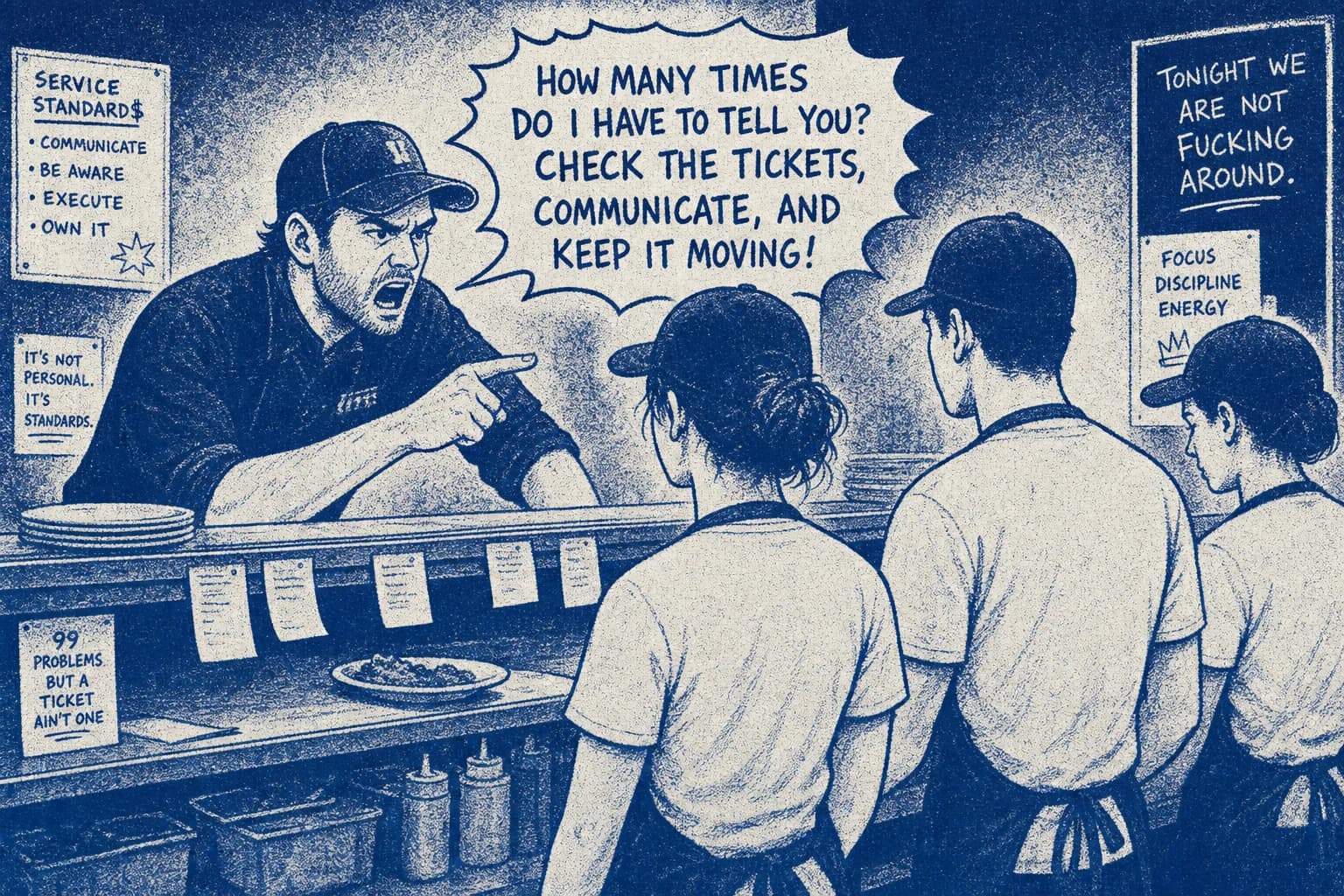
Most restaurant “1-on-1s” are not meetings. They are tense booth conversations after a guest complaint or a five-minute warning that leaves the employee defensive and you drained. You care about development—you promote from within, you remember names, you cover shifts—but without a restaurant manager 1-on-1 coaching script, strong performers miss growth talks and struggling performers get vague warnings.
High-performing teams treat coaching like pre-shift: standardized, brief, and repeatable. The goal is clarity, accountability, and a record—without killing morale or spending an hour per person per week. This article gives you CLEAR, a full script template, and pushback roleplay for when employees deflect. If coaching needs to escalate, use the progressive discipline policy guide to keep the next step consistent with the handbook.
Root Cause Analysis
No protected time. Coaching happens when the problem explodes, not on a rhythm. Calendar invites feel impossible until you realize one skipped 1:1 costs a termination conversation later.
Skill gap. Many GMs were promoted for speed and guest rapport, not facilitated dialogue. They either avoid hard topics or over-talk.
Floor as the default venue. Guests, noise, and audience make honesty rare and documentation embarrassing.
Outcome confusion. Is this a pep talk, a warning, or career development? Employees cannot tell; neither can HR reading your notes.
No close loop. Managers give feedback but never name the next check-in or measurable change, so nothing sticks.
Fear of engagement surveys. Some leaders avoid 1:1s because “they might complain.” Structured coaching reduces surprise complaints because issues surface early.
CLEAR fixes the structure; your discipline is putting it on the calendar like inventory.
The Actionable Framework
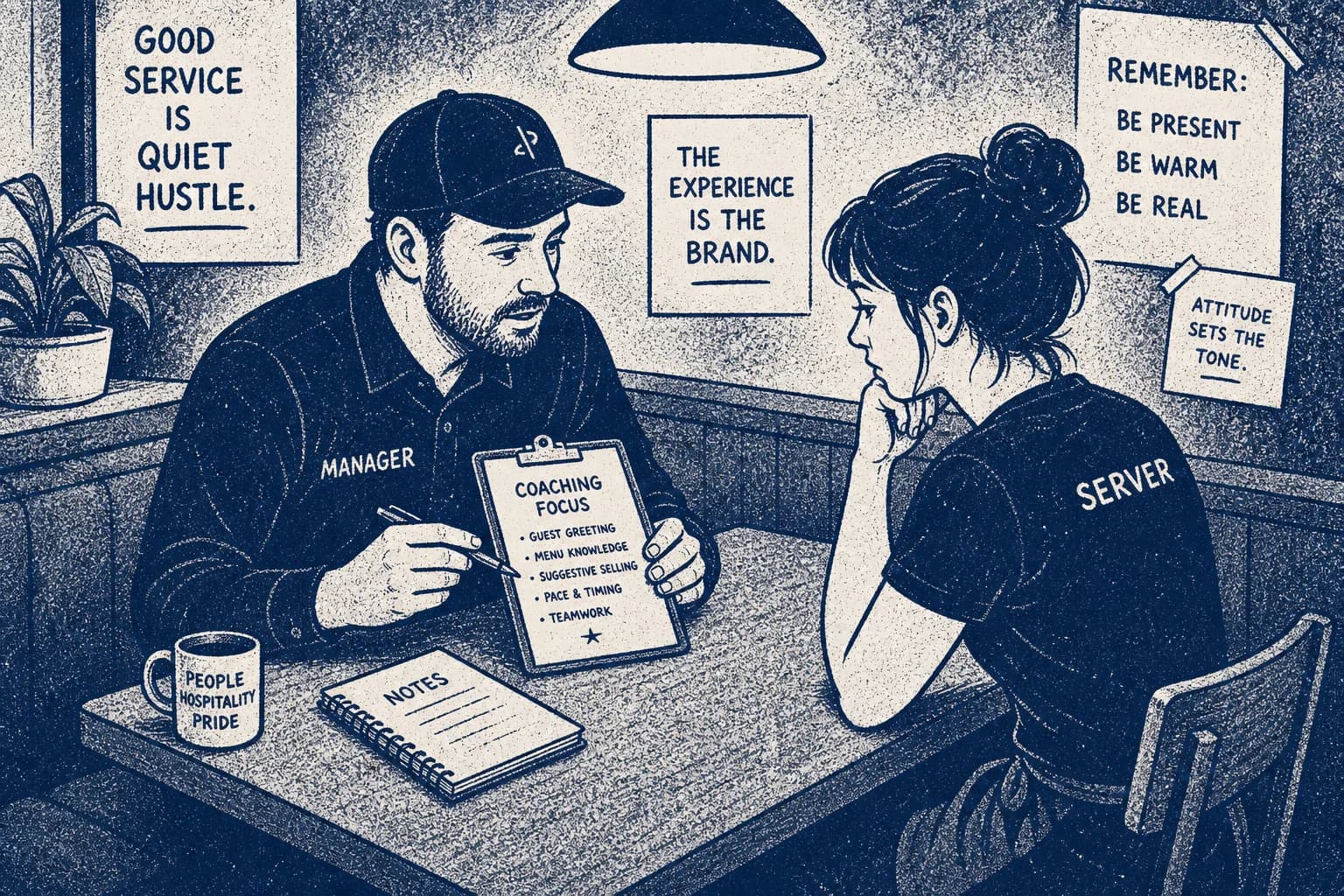
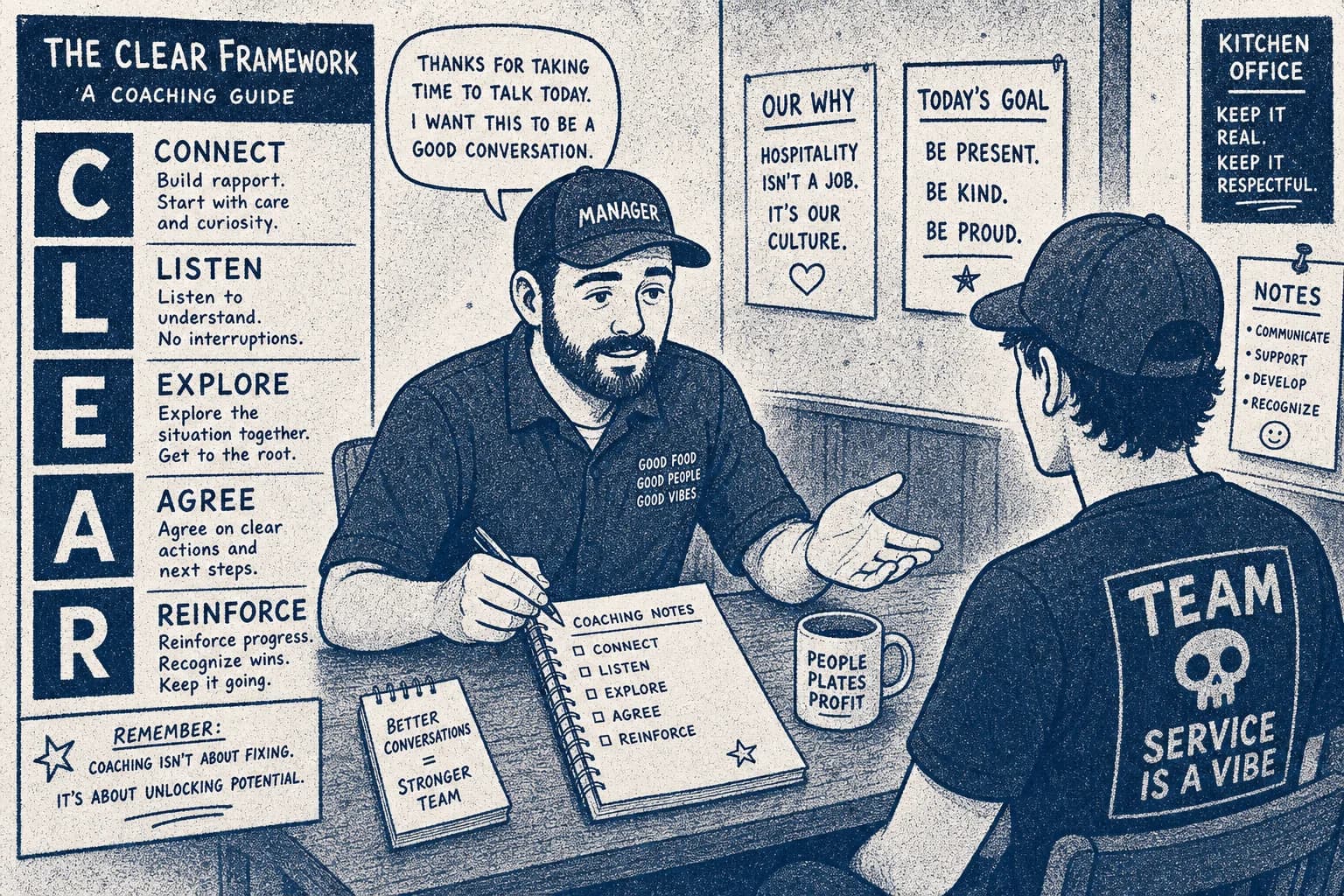
CLEAR 1:1 Structure (15–20 minutes, off floor)
| Step | Purpose | Time |
|---|---|---|
| C — Context | Why we are meeting; tie to role, shift, or business | 2 min |
| L — Listen | Their view on performance, blockers, goals | 5 min |
| E — Expectation | Non-negotiable standards (handbook + role) | 3 min |
| A — Action | 1–3 specific behaviors + dates + your support | 5 min |
| R — Record | Summarize; document; schedule follow-up | 2 min |
Run monthly for all leads and key hourly staff you are developing; weekly for anyone on a performance or attendance plan. Never combine a termination decision with a “development” CLEAR session without transparency—if it is final warning territory, say so in Context.
Full 1:1 Script Template
RESTAURANT MANAGER 1:1 — CLEAR COACHING SCRIPT
Employee: ___________________  Role: ___________________  Date: _________
Manager: ___________________  Location: ___________________  Duration: ___ min

—— C — CONTEXT ——
“Thanks for sitting down. This is our regular check-in—not trouble by default.
I want to align on how [shift/role] is going and what ‘great’ looks like here.
Today I’ll also share what I’m seeing on [metric/behavior: sales, check times, sidework, guest comments].”

[If corrective tone needed:]
“I also need to address [specific FACT from recent shift]. We’ll get to that in Expectation and Action.”

—— L — LISTEN ——
“What’s going well for you right now?”
[Note strengths—use in recognition file.]

“What’s harder than it should be—tools, training, schedule, team dynamics?”
[Listen; do not solve every problem in the room. Capture 1–2 you can own.]

“Anything you want me to know as your manager?”
[Pause. If silent: “I’ll take that as nothing urgent—fair?”]

—— E — EXPECTATION ——
“For [role], our standards are:
• [Standard 1 — e.g., greet within 30 seconds / complete sidework checklist]
• [Standard 2 — e.g., no sidework left for next shift]
• [Standard 3 — e.g., communication to MOD when running late on large parties]

Handbook reference if corrective: Section ___ — [title].”

—— A — ACTION ——
“Here’s what I need from you before we meet again on [date]:
1. [Measurable behavior] by [date].
2. [Measurable behavior] by [date].
What I will do to support you:
• [Training / shadow / schedule adjustment / check-in mid-week]

Does that feel doable? What would get in the way?”

[Negotiate only on method, not on standards.]

—— R — RECORD ——
“Recap: You’re working on [1–3 actions]. I’m providing [support]. We meet again [date/time].
I’ll note this in your file as today’s coaching conversation.”

Signatures if formal plan: Employee ______ Manager ______
Docu-Coach™ follow-up reminder: [date]

POST-MEETING (manager, 2 min)
Log the coaching session in Docu-Coach™: FACT summary, employee quotes (brief), actions, follow-up date. Docu-Coach™ generates the record from your session notes and sets the follow-up reminder automatically—the file is done before the next shift starts.
Preparing in Five Minutes (before they walk in)
- Pull one positive and one corrective data point (POS, guest comment, peer feedback, your observation).
- Know the one behavior that matters most this cycle—not ten.
- Book a room with a door or a quiet patio table—not the line.
Pushback Roleplay (stay on CLEAR)
Practice these responses out loud once a quarter with your fellow MOD.
| Employee pushback | Manager response (calm, repeat Expectation) |
|---|---|
| “Nobody told me that rule.” | “The standard is in the handbook / pre-shift. Going forward the expectation is [X]. Today we’re focused on [action] by [date].” |
| “You’re singling me out.” | “I coach everyone on standards. Here’s the specific behavior I observed on [date]: [FACT].” |
| “That other server does it too.” | “I’m responsible for your performance today. If I see it elsewhere I address it. For you: [action].” |
| “I can’t because of schedule/kids.” | “Tell me what schedule change would help once. The standard still stands. Let’s pick one doable action by [date].” |
| “This is stupid / I’m quitting.” | “I’m sorry you’re frustrated. If you choose to stay, the expectation remains. HR is available if you want to discuss separation.” |
| Silence / shrugs | “I need a yes that you understand the action items. Can you repeat back what you’re committing to?” |
Do not debate personality. Return to Expectation and Action. If threats or harassment appear, pause and escalate per policy.
Rhythm for Restaurant Reality
| Role | Suggested cadence | Focus |
|---|---|---|
| Shift lead / key holder | Biweekly | Delegation, MOD decisions, documentation |
| Server / cook (development track) | Monthly | Skills, guest impact, career path |
| Performance plan | Weekly | Single metric + attendance/behavior |
| High performer | Monthly | Retention, growth, input on process |
Frequently Asked Questions
What is the CLEAR coaching framework for restaurant managers?
Context, Listen, Expectation, Action, Record—a 15–20 minute off-floor 1:1 structure that ties behavior to handbook standards and ends with documented follow-up.
How often should restaurant managers hold 1-on-1s?
Monthly for leads and developing hourly staff; weekly for anyone on a performance or attendance plan; biweekly for shift leads on documentation and MOD decisions.
Should 1-on-1 coaching be documented?
Yes. Log date, FACT behaviors discussed, standards cited, agreed actions, follow-up date, and employee response same day—before the next shift starts.
Where should coaching conversations happen?
Off the floor: private office, quiet patio table, or closed door—not expo line corrections in front of guests and crew.
Is a 1-on-1 the same as a write-up?
No. CLEAR 1:1s are development and expectation-setting. After two cycles with documented actions and no improvement, escalate to formal corrective action per handbook.
How do managers handle pushback in 1-on-1s?
Return to Expectation and Action—repeat the specific behavior and measurable commitment. Do not debate personality or compare to other employees at length.
Can Docu-Coach™ log 1-on-1 coaching sessions?
Yes. CLEAR fields map to structured entries with automatic follow-up reminders and chronological employee timelines.
How do I get started with Docu-Coach™ for coaching documentation?
Book a demo at docu-coach.com/demo or email hello@docu-coach.com for a 30-day trial walkthrough.
The Paper Trail and Legal Safeguard
A 1-on-1 is not automatically a write-up. It is documentation when you state expectations and actions and log a short summary in Docu-Coach™. That protects you when someone claims they were never coached.
Pro tip: A 1-on-1 without a same-day file entry did not happen for legal purposes. Log CLEAR summary before the next shift—counsel and UI boards treat undocumented coaching as nonexistent.
Record before you leave: Date, attendees, FACT behaviors discussed, standards cited, agreed actions, follow-up date, employee’s words (one or two sentences). Docu-Coach™ prompts these fields at the end of each CLEAR session—the record is in the file, not on a sticky note, before the next guest walks in.
For the shorter version of that record—the five-sentence note after a single floor correction—see restaurant employee coaching, which also covers the ninety-second correction to use mid-service instead of a full CLEAR session.
Avoid
- Promising outcomes you cannot control (“you’ll get the best section every night”).
- Labeling (“unmotivated”) without behavior.
- Recording secretly; inform them you note coaching conversations.
Align with discipline: If the same issue appears after two CLEAR cycles with documented actions, move to formal corrective action per handbook—not a third pep talk with no paper.
Coaching scripts create progressive discipline without surprise—the employee heard the standard, agreed or declined, and had a date to show improvement.
Natural Solution Contextualization
The restaurant manager 1-on-1 coaching script is not about sounding like corporate HR. It is about giving your best people growth and your struggling people a fair shot before escalation—on a schedule you can actually keep.
Docu-Coach™ turns CLEAR sessions into filed coaching notes in minutes: Context and Action fields map to structured entries, follow-up dates remind you before the next rush, and HR sees a chronological timeline instead of “I talked to them” in a text thread. You run the conversation face to face; the app handles the record so your next MOD is not starting from zero.
Block two 1:1s per week on the calendar. Use the template until it feels natural. Your team will feel more led and less ambushed—and your files will finally show the leader you already are on the floor.
Explore this topic
Related Resources
Restaurant Employee Coaching
How restaurant managers coach on a busy floor and document it: the 90-second correction, the private sit-down, what a coaching note contains, and why coaching is what makes later discipline hold.
6 min read · September 2026
Chronic Attendance in Restaurants: Pattern Coach Plan Protocol and PIP That Holds Up
Third no-call this month? Use the Pattern Coach Plan for chronic restaurant attendance—coaching script, PIP outline, and morale rules that protect the team.
8 min read · September 2026
Restaurant Employee HR Documentation System: From Scattered Notes to Audit-Ready Files
Empty employee files and sticky-note write-ups cost you at unemployment hearings. Build a unified restaurant HR documentation system that scales across locations.
8 min read · September 2026
How to Write Up a Restaurant Employee Legally: FACT Method and Defensible Templates
Stop writing 'bad attitude' write-ups that fail in HR. Use the FACT method, strip emotion from discipline, and generate defensible corrective actions in Docu-Coach™.
8 min read · September 2026
How Much Does an Unemployment Claim Cost an Employer?
Does an unemployment claim cost the employer? Yes. See the unemployment claim cost to employer—UI charges, SUTA rate hikes, and a free by-state calculator.
10 min read · September 2026
How Restaurants Lose Unemployment Claims Due to Poor Documentation
Restaurants lose UI claims when they cannot prove misconduct with dated records—not when they lack a lawyer. Build the documentation pack hearings require.
5 min read · September 2026